FAIR USE NOTICE

FAIR USE NOTICE

A BEAR MARKET ECONOMICS BLOG

DEDICATED TO OCCUPY AND THE ECONOMIC REVOLUTION

OCCUPY THE MARKETPLACE

FOLLOW ME ON FACEBOOK

This site may contain copyrighted material the use of which has not always been specifically authorized by the copyright owner. We are making such material available in an effort to advance understanding of environmental, political, human rights, economic, democracy, scientific, and social justice issues, etc. we believe this constitutes a ‘fair use’ of any such copyrighted material as provided for in section 107 of the US Copyright Law.

In accordance with Title 17 U.S.C. Section 107, the material on this site is distributed without profit to those who have expressed a prior interest in receiving the included information for research and educational purposes. For more information go to: http://www.law.cornell.edu/uscode/17/107.shtml

If you wish to use copyrighted material from this site for purposes of your own that go beyond ‘fair use’, you must obtain permission from the copyright owner.

FAIR USE NOTICE FAIR USE NOTICE: This page may contain copyrighted material the use of which has not been specifically authorized by the copyright owner. This website distributes this material without profit to those who have expressed a prior interest in receiving the included information for scientific, research and educational purposes. We believe this constitutes a fair use of any such copyrighted material as provided for in 17 U.S.C § 107.

Read more at: http://www.etupdates.com/fair-use-notice/#.UpzWQRL3l5M | ET. Updates

All Blogs licensed under Creative Commons Attribution 3.0

Monday, August 24, 2015

“CORRUPTION HAS LEFT A STAIN ON HUMANITY”


space for transparency


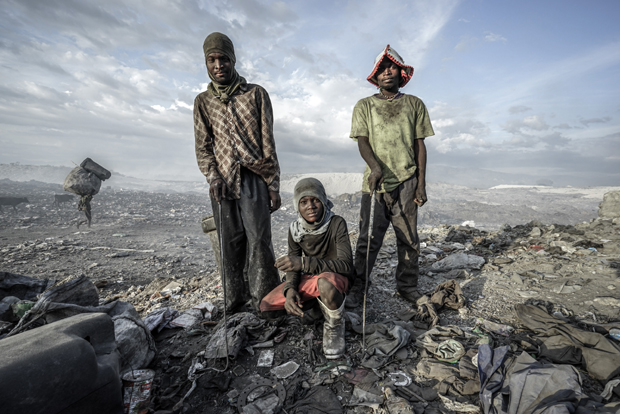
PHOTO COMPETITION WINNER: “CORRUPTION HAS LEFT A STAIN ON HUMANITY”


Earlier this year, we teamed up with the Thomson Reuters Foundation and the International Anti-Corruption Conference to launch “Capture Corruption”, a global photo competition for the most powerful images of corruption and its devastating impact on lives around the world.
Today, we’re revealing the winning selection. In first place in our 31+ category is Giles Clarke – selected from more than 1500 entries for his image of pollution and exploitation at a Haitian landfill. We asked Giles to tell us the story behind his winning image.
Copyright Giles Clarke / Getty Images Reportage
Capture Corruption global photo competition, first place winner, 31+. Copyright Giles Clarke / Getty Images Reportage
Congratulations on winning the photo competition. Your photo shows a vast waste dump just outside Haiti’s capital city, Port au Prince. Why does this image sum up corruption for you?
For me the image represents Haiti, and its desperate struggle to lift itself from the depths of misery and corruption that has plagued the country – by far the most corrupt in the Americas – for decades.
The vast landfill is owned by the government and situated directly above the Plain Cul-De-Sac aquifer – the same water that provides drinking water for the poorest neighbourhoods of Port-Au-Prince. For me, this neglect by the Haitian government motivated my need to tell this story.
There are around 2,000 people who make up this ‘dump community’. They don’t have medical help or clean water to wash in. There are mountains of dioxin-smoking waste that grow daily only yards from where families live in rough tin shacks.
Your photo focuses on three workers at the landfill. What did you find out about the men and their experiences?
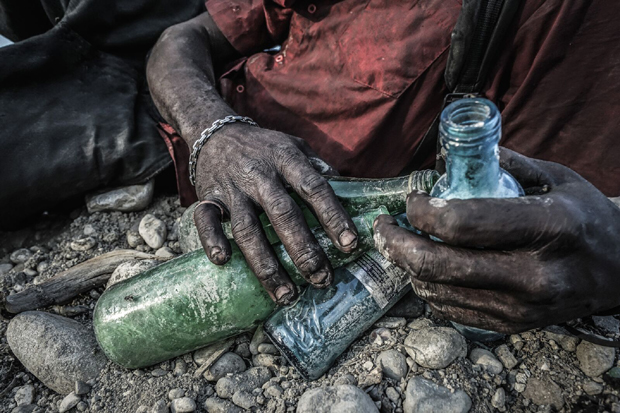
They all have grave health issues – one look at their hands was enough to understand the problem. There is no running water and they live in dirt and smoke 24 hours a day. They all want the ability to work but without any programmes or jobs offered, this is their best option.
Copyright Giles Clarke / Getty Images Reportage
Despite these alarming growing health issues related to the toxins being carelessly dumped, none of the solid waste disposal companies contracted by the government provide their workers with anything more than plastic gloves.
“Corruption has left an indelible stain on humanity all over the world […] This is my motivation- to explore ways to expose these injustices and shed light on just a few of these deplorable situations.”
What do you think needs to change to deal with the problem?
Like many issues affecting developing countries, the key has to be educating the general public – in this case toward recycling education coupled with governmental funds diverted to recycling banks and equipment. Without those awareness programmes and the practical ability to recycle, supported by local government agencies, this issue will drag on for years.
What motivates you to capture the effects of corruption in Haiti and around the world?
My motivation is creating awareness to lessen the inequality gap and, ideally, help drive our political leaders toward creating a fairer and more sustainable future. Corruption is driven by greed – a terrible reality for many less fortunate people and a blight on our common humanity. Sometimes, unfortunately, I feel we almost need to publicly shame these people into action.
Follow Giles Clarke on Instagram: @clarkegiles

Friday, August 21, 2015

Debunking trickle down economics: The real reasons for the collapse of the Middle Class explained

The News Hub


Debunking trickle down economics

The real reasons for the collapse of the Middle Class explained


Ever since the 1980's the Republican party has incorporated the hypothesis of trickle down economics into the very heart of it's fiscal policy initiatives. It consists of the belief that cutting taxes for corporations and the wealthy will allow them to invest more into the economy, create jobs and improve conditions for everyone.

But how does this belief measure up to economic trends? One quick way to measure this is to compare levels of income inequality with the corresponding top marginal tax rates. If tax cuts on the rich benefited all of society equally than we should be seeing a very small change in the level of inequality. Instead we see this:


Image provided courtesy of the film: Inequality for all

As the graph clearly shows decreases in the top marginal tax rate come with enormous increases in the percentage of American wealth owned by the top one percent. So what effect does this have on the remainder of Americans. Haven't their wages increased at all?

Actually, quite the opposite has occurred. The typical male worker in 1978 made 44,308 US Dollars (adjusting for inflation) per year. As of 2010 the income of the typical male worker has decreased to a meager
$ 33,751/yr, a shocking statistic when you consider that the average wage of a top one percent earner has increased to $ 1,101,089. This being the case, why hasn't any of that enormous wealth "trickled down" to the majority of Americans?

The answer to this dilemma lies in the rarely acknowledged fact that the true spenders and job creators of every economy are the members of the middle class. If this idea seems revolutionary to you consider the following. What are the similarities in financial habits between the ultra rich and the middle class? Do they not both have the same basic necessities; 3 meals a day, a car, a home... While it is true that the one percent may spend their money on more luxurious versions of the same products (Lamborghini vs Mazda) they are eventually left with large amounts of disposable income. In an increasingly globalized world in which it is much cheaper to purchase goods in foreign markets and then import them into the US, this income is unlikely to be invested directly into the American economy.

On the other hand when the marginal tax rate is increased, the government can afford to invest directly in it's population by funding social welfare programs and and providing financial aid to make college more affordable. This in turn creates a highly skilled workforce which can now afford to spend more of it's income in and way that directly benefits the American economy by eating out and buying more expensive amenities than they could previously afford. To meet this increased demand companies are forced to hire more employees in the service industry which in turn reduces unemployment.

Tuesday, August 18, 2015

The Concept Of Ownership Is About To Change Radically If John Deere Has Its Way


The Concept Of Ownership Is About To Change Radically If John Deere Has Its Way


The Concept Of Ownership Is About To Change Radically If John Deere Has Its Way
Credit: Peter Mooney
These are the sorts of intellectual property "rights" the TPP intends to codify in member nations. Now you can't "buy" things, you can only rent them. Via Wired:

IT’S OFFICIAL: JOHN Deere and General Motors want to eviscerate the notion of ownership. Sure, we pay for their vehicles. But we don’t own them. Not according to their corporate lawyers, anyway.
In a particularly spectacular display of corporate delusion, John Deere—the world’s largest agricultural machinery maker —told the Copyright Office that farmers don’t own their tractors. Because computer code snakes through the DNA of modern tractors, farmers receive “an implied license for the life of the vehicle to operate the vehicle.”
It’s John Deere’s tractor, folks. You’re just driving it.
Several manufacturers recently submitted similar comments to the Copyright Office under an inquiry into theDigital Millennium Copyright Act. DMCA is a vast 1998 copyright law that (among other things) governs the blurry line between software and hardware. The Copyright Office, after reading the comments and holding a hearing, will decide in July which high-tech devices we can modify, hack, and repair—and decide whether John Deere’s twisted vision of ownership will become a reality.

(This is an important issue for farmers: a neighbor, Kerry Adams, hasn’t been able to fix an expensive transplanter because hedoesn’t have access to the diagnostic software he needs. He’s not alone: many farmers are opting for older, computer-free equipment.)Over the last two decades, manufacturers have used the DMCA to argue that consumers do not own the software underpinning the products they buy—things like smartphones, computers, coffeemakers, cars, and, yes, even tractors. So, Old MacDonald has a tractor, but he owns a massive barn ornament, because the manufacturer holds the rights to the programming that makes it run.

What does any of that have to do with copyright? Owners, tinkerers, and homebrew “hackers” must copy programming so they can modify it. Product makers don’t like people messing with their stuff, so some manufacturers place digital locks over software. Breaking the lock, making the copy, and changing something could be construed as a violation of copyright law.In recent years, some companies have even leveraged the DMCA tostop owners from modifying the programming on those products. This means you can’t strip DRM off smart kitty litter boxes, install custom software on your iPad, or alter the calibration on a tractor’s engine. Not without potentially running afoul of the DMCA.
And that’s how manufacturers turn tinkerers into “pirates”—even if said “pirates” aren’t circulating illegal copies of anything. Makes sense, right? Yeah, not to me either.

It makes sense to John Deere: The company argues that allowing people to alter the software—even for the purpose of repair—would “make it possible for pirates, third-party developers, and less innovative competitors to free-ride off the creativity, unique expression and ingenuity of vehicle software.” The pièce de résistance in John Deere’s argument: permitting owners to root around in a tractor’s programming might lead to pirating music through a vehicle’s entertainment system. Because copyright-marauding farmers are very busy and need to multitask by simultaneously copying Taylor Swift’s 1989 and harvesting corn? (I’m guessing, because John Deere’s lawyers never explained why anyone would pirate music on a tractor, only that it could happen.)

John Deere is a company, by the way, that is seriously serious about preventing people from copying their stuff. So serious, in fact, that they even locked the PDF they sent to the Copyright Office. No modifying the document. And no copying passages. Really, John Deere? How am I supposed to highlight all that's wrong in this document now?

John Deere may be out of touch, but it’s not alone. Other corporations, including trade groups representing nearly every major automaker, made the same case to the Copyright Office again and again. It’s worth noting Tesla Motors didn’t join automakers in this argument, even though its cars rely heavily on proprietary software.
General Motors told the Copyright Office that proponents of copyright reform mistakenly “conflate ownership of a vehicle with ownership of the underlying computer software in a vehicle.” But I’d bet most Americans make the same conflation—and Joe Sixpack might be surprised to learn GM owns a giant chunk of the Chevy sitting in his driveway.
Other automakers pointed out that owners who make unsanctioned modifications could alter their vehicles in bad ways. They could tweak them to go faster. Or change engine parameters to run afoul of emissions regulations.

GM went so far as to argue locking people out helps innovation. That’s like saying locking up books will inspire kids to be innovative writers, because they won’t be tempted to copy passages from a Hemingway novel. Meanwhile, outside of Bizarroland, actual technology experts—including the Electronic Frontier Foundation—have consistently labeled the DMCA an innovation killer. They insist that, rather than stopping content pirates, language in the DMCA has been used to stifle competition and expand corporate control over the life (and afterlife) of products.They’re right. Thatcould happen. But those activities are (1) already illegal, and (2) have nothing to do with copyright. If you’re going too fast, a cop should stop you—copyright law shouldn’t. If you’re dodging emissions regulations, you should pay EPA fines—not DMCA fines. And the specter of someone doing something illegal shouldn’t justify shutting down all the reasonable and legal modifications people can make to the things they paid for.
“The bad part is, my sense is, these companies are just locking up this technology, and increasing the sort of monopoly pricing structure that just doesn’t work for us,” Brian Talley, a farmer on California’s central coast, says of restrictions placed on his equipment. I toured his farm with a fellow from the Intellectual Property & Technology Law Clinic so we could tell the Copyright Office how manufacturers are hampering farmers. “We are used to operating independently, and that’s one of the great things about being a farmer. And in this particular space, they are really taking that away from us.”

Thankfully, we aren’t alone. There’s a backlash against the slow creep of corporate product control.The Electronic Frontier Foundation, theIntellectual Property & Technology Law Clinic, and the Digital Right to Repair Coalition(Disclaimer: I’m a founding member of the Coalition.) are fighting to preserve the notion of ownership. We’re trying to open the floodgates of information. To let owners investigate the code in their devices. To modify them for better functionality. To repair them, even without the blessing of manufacturer.
Earlier this year, consumers sent 40,000 comments to the Copyright Office—all of them urging the restoration of ownership rights. The year before, consumers and activistsforced a law through Congress that made it legal to unlock a cellphone and move it to a different carrier.
This week, Senator Ron Wyden and Representative Jared Polis will introduce the “Breaking Down Barriers to Innovation Act of 2015, which would substantially improve the DMCA process. Lawmakers in Minnesota and New York have introduced “Fair Repair” legislation that assert an owner’s right to repair electronic equipment they’ve purchased. They want equal access to repair information, replacement parts, and security updates.
Of course, taking back the stuff that we own won’t be easy. Corporations have better lobbyists than the rest of us. And, somehow, the notion of actually owning the things you buy has become revolutionary.
It doesn’t have to be. Tell the Copyright Office to side with consumers when it decides which gadgets are legal to modify and repair. Urge lawmakers to support legislation like the Unlocking Technology Act and the Your Own Devices Act, because we deserve the keys to our own products. And support Fair Repair legislation.
If you bought it, you should own it—simple as that. It’s time corporate lawyers left the bullshit to the farmers, who actually need it.
Go Back to Top. Skip To: Start of Article.
  • Monday, August 17, 2015

    6 Creative New Techniques Republicans Have Developed for Torturing the Poor


    Home


    ECONOMY
    Republican-controlled states are sharpening their fight against the poor, and then paralyzing their attempts to fight back.


    In the 1960s, the Lyndon Johnson administration launched an official War on Poverty. Needless to say, poverty has emerged victorious. The noble and necessary aim of poverty reduction might have helped millions of people create lives of decency and dignity, and it might have helped America assimilate into the developed world as a fiscally responsible and morally honorable nation. But since they fail to narrow the profit margin of the corporate class running America’s political system, poverty reduction programs are basically doomed. 
    As poverty worsens and spreads, with 25 million Americans constituting the working poor, poverty relief programs face elimination from austerity policymakers on the state and federal levels. In the absence of any war on poverty, America has demonstrated dedication and determination in its war on the poor. In a cruel combination of exploitative profiteering from poverty, and unapologetic hatred for the poor, state governments continue to pick the pockets of the impoverished, relegating low-income earners to a vicious cycle of punishment and recompense; life without parole in the poverty prison.
    The war on the poor exposes the tyrannical turn of political administration in the United States – a country committed to mutating its criminal justice system, already more criminal than just, into an apparatus of assault against its most defenseless citizens.
    The following laws and policies give painful illustration to America’s attack on the poor in which the impoverished receive perpetual punishment for their poverty. This compilation does not include the mile-long list of policies that harm the poor, such as difficulty acquiring health care and child care, regressive taxation, or the cost of college. The following are policies in which state governments are actively levying the legal system against the poor.
    1. Limits on ATM Withdrawals for Welfare Recipients in Kansas
    Governor Sam Brownback and his supporters in the state legislature of Kansas have turned their state into dystopian inspiration for a post-apocalyptic thriller, slashing social services, and leaving the poor to suffer — and in many cases actually die — for lack of basic essentials. In April, Brownback signed a bill making it illegal for welfare recipients to withdraw more than $25 from an ATM at one time. Although the policy might violate federal law, state officials have recently expressed steadfast commitment to its implementation and enforcement. The policy manages to achieve the trifecta of mean-spiritedness, dangerous negligence of human needs, and Orwellian intervention into the private lives of citizens from the state. 
    2. Revocation of Driver’s License in Iowa For Missing Student Loan Payments
    Failure to make student loan payments in Iowa will result in delinquent borrowers losing their driver's licenses. With student loan defaults on the rise, and rates of poverty, even among the college-educated, increasing, states are developing punitive measures to damage the lives of those already buried in student debt. Tennessee will revoke the nursing license of a nurse who fails to make student loan payments. Iowa is the worst offender, however. Losing the ability to drive, especially in a largely rural state without sophisticated public transit, will reduce the potential for poor people to work, take children to school and take any step toward escaping poverty. (Montana had a similar law that was repealed.)
    3. Arkansas Arrests and Prosecutes People for Missing Rent Payments
    According to an in-depth, detailed investigation by Human Rights Watch, “Arkansas is the only US state where tenants can end up as convicted criminals because they did not pay their rent on time.” Arkansas has a unique and singularly monstrous “failure to vacate” law. Failure to Vacate allows prosecutors to charge tenants as criminals without any evidence outside the landlord’s testimony. Tenants face fines far exceeding the rent they owe, and in many cases, a sentence of jail time.
    Violation of Failure to Vacate will also appear on the tenant’s criminal record. If a tenant fails to pay rent on time, the landlord instructs them to leave the premises, and the tenant is still present after a grace period of 10 days, the tenant falls onto the vicious mercies of the draconian criminal justice system. One missed paycheck, one unexpected expense or one pink slip, and 10 days is all that separates poor renters in Arkansas from imprisonment and a criminal record.
    4. Using the Poor as ATMs: Harsh Financial Penalties for Minor Infractions and Traffic Violations
    The Justice Department did not find cause to prosecute former Ferguson, Missouri police officer Darren Wilson in the killing of Michael Brown, but it did gather undeniable evidence proving that the poor, and in this case, mostly black residents of Ferguson live under occupation from the Ferguson police force. “Officers routinely conduct stops that have little relation to public safety and a questionable basis in law,” the Department of Justice explained. “Issuing three or four charges in one stop is not uncommon,” according to the report, “Officers sometimes write six, eight, or, in at least one instance, fourteen citations for a single encounter.” In 2012, 19 percent of Ferguson’s budget derived from the imposition of fines and court fees. 
    Ferguson is not alone in viewing the poor as living, breathing ATMs. New York over the past 10 years has consistently adopted “broken windows” policing policies. Many poor citizens live in constant terror of police penalty, because without enough money to pay their fines and court fees, they can land in jail.
    5. The Return of Debtors’ Prisons
    After an exhaustive study of legal harassment and predatory targeting of the poor in Louisiana, Michigan, Ohio, Georgia, and Washington, the ACLU concluded “that poor defendants are being jailed at increasingly alarming rates for failing to pay legal debts they can never hope to afford.” The Supreme Court ruled the imprisonment of poor people for failure to pay legal fees unconstitutional, but many states ignore the law with impunity, as their powerless victims have little recourse to challenge their jailers. In Georgia, to cite one egregious example, authorities prosecuted a mentally ill teenager for stealing school supplies. The cost of her incarceration in juvenile detention centers came to a total of $4,000. The teenage girl was released only after her mother was able to pay the bill in full. In the Georgia case, and many others across America, the state functions as hostage taker, demanding family members pay ransom for the release of their loved ones.
    6. Voter Identification Requirements Suppress Poor People’s Votes
    Voter Identification requirements in southern states, and elsewhere, make it much more difficult for the poor to exercise their civic right to oppose the very policies, such as those enumerated above, that damage them. 
    Suppression schemes, especially ID laws, harm only those who cannot afford a photo ID. The Brennan Center for Justice at the New York University School of Law studied the results of voter identification regulations in Texas, and concluded, in the words of its director, Myrna Perez, “The law has a disenfranchising effect. It hits poor voters the hardest.” 
    In a deadly one-two punch of democracy deterrence, many American states are now levying the political and legal system as a weapon against the poor, and then paralyzing the poor in their attempt to fight back.
    ***
    Norman Mailer, while promoting his novel about the life of Jesus Christ, The Gospel According to The Son, explained that anxiety troubles the American heart, because most Americans identify as Christians and prefer to pretend they live in a “Christian nation,” but on some deep, intuitive level suffer from the awareness that they violate the basic principles of Christianity on a daily basis. The Synoptic Gospels are filled with excoriations of the rich, and implorations to help the poor. 
    The ongoing transformation of the criminal justice system into a harassment and exploitation enterprise targeting “the least of these,” to use Biblical language, exposes America as a nation not only indifferent to the suffering of the poor, but enthusiastic in its commitment to enhance that suffering. 
    David Masciotra is the author of Mellencamp: American Troubadour (University Press of Kentucky). He has also written for Salon, the Atlantic and the Los Angeles Review of Books. For more information visit www.davidmasciotra.com.

    Saturday, July 4, 2015

    Why the Middle Class Keeps Giving Itself the Shaft


    Mr. Money Mustache


    Why the Middle Class Keeps Giving Itself the Shaft

    stash_signal


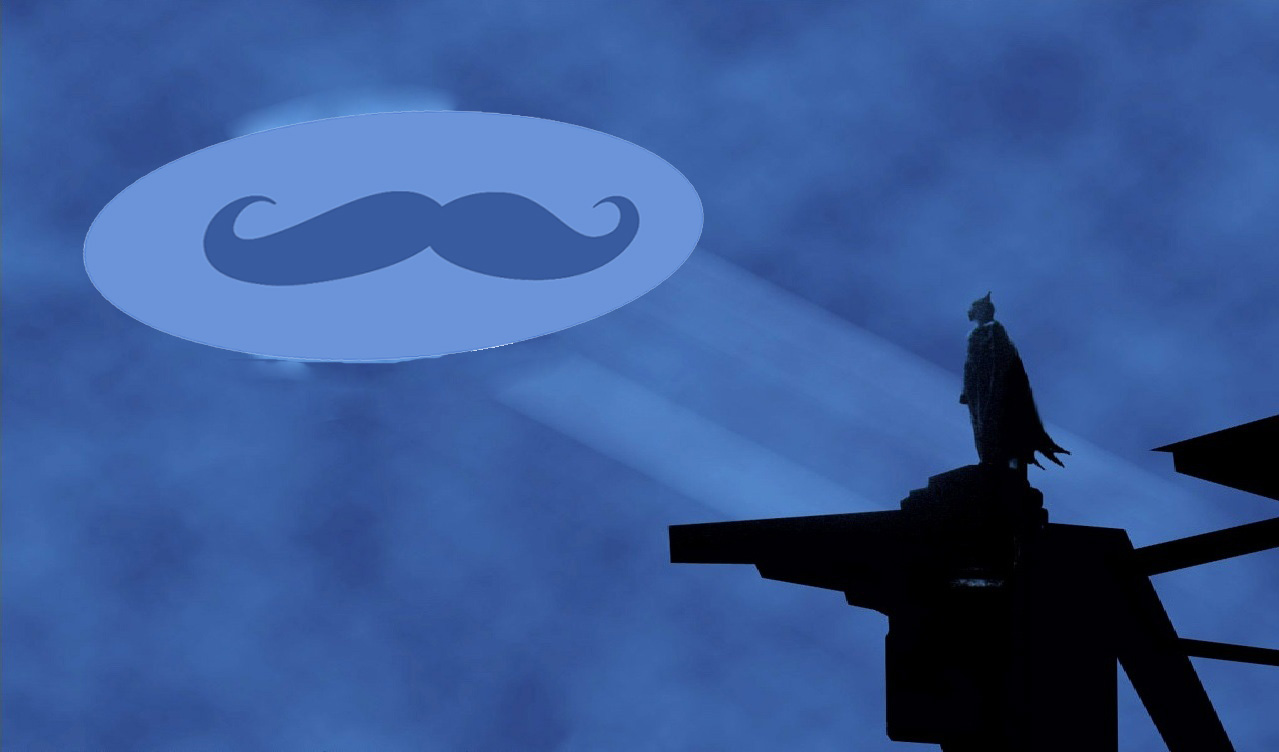
    Oh man. I was halfway through writing a nice, technical, do-it-yourself article about Radiant Heat for you, when the night sky over Longmont lit up with the giant ‘Stache Symbol*. It seems that our national network of Antimustachian Media Drivel detection volunteers sounded the alert based on this incredible doozy of an article about retirement in the US version of the Guardian. We need to make fun of it before we can go on with our regular lives.

    The article is crippled by a few financial errors, but much more important is the hopelessly self-defeating tone of the thing. It manages to advocate shitting your own financial pants for the entire course of a lifetime, while simultaneously being sassy and witty about it so that you think the advice is perfectly reasonable. Just take a look at this early paragraph:

    “Indeed, all you need to do is save 22 times the annual income you hope to have when you retire. That means if you make $150,000, and hope to retire on $100,000 a year, you only need to sock away $2.2m in a bank account to be able to retire comfortably.”
     
    Yes, that is all you need to do. If you make $150,000 per year, not only is it easy to amass 2.2 million dollars, but you should soon find chunks of that size floating all around you. You might have this much just sitting in your sock drawer waiting until you next get to the ATM machine to deposit it.

    But wait.. this is necessary so you can retire on $100,000 per year!?! Are we planning to retire to the president’s suite of the Hyatt Regency? Or live in a Monaco Dynasty RV which we park on a 75MPH treadmill during vacations in order to maintain maximum fuel consumption? Who the hell needs $100,000 per year to retire?

    So the article bakes ridiculousness right into its opening argument. Not a good start for a publication which supposedly has a reputation as “an organ of the middle-class.” But let’s read on.


    “It’s simply a math problem. Let’s say you are in your 40s, making $150,000 a year, a generous salary in almost any city in the country. The taxman cometh, does he not? That $150,000, after taxes, becomes the slightly less dazzling sum of $100,000 a year.”
     
    Okay.. except let’s assume you’re not a total idiot and that you contribute to your 401(k) plan, which shields the first $17,500 from taxes, or more likely $35,000 since most people in this age and income demographic are part of a couple filing jointly and sharing the $150k income. After all, we can at least assume that the $100,000 retirement budget mentioned earlier was not for a single person, right?


    “Now you have to save that money as well as living on it. How much can you save? A standard and sensible budget, advocated by LearnVest and others, is to use a simple formula called 50/20/30. This means that you spend 50% of your salary on expenses. Another 30% goes to lifestyle expenses – the things that make life liveable unless you prefer living in a hut: cable and phone plans, clothes, books, gym fees, childcare and pets, restaurants and entertainment. “
    Wait a minute here. You say I am spending 50% of my salary on expenses, and I make $150,000 per year, which is much more than average. So that’s $75,000. But then how do other people who make $25,000 live while spending only $12,500 on expenses? And what about $1.5M earners – do their expenses automatically rise to $750,000? Something is fishy here.


    Then the final 20% goes to saving for retirement.  This is a reasonable budget. If you save more than 20% of your salary for retirement, you’re giving up enjoying your present life: you’re dedicating yourself to living in holy denial of all worldly pleasures like a monk or a nun, in the hopes of a lavish, or at least an exceedingly comfortable, life when you’re over 60-years-old. Twenty percent for retirement is, by the way, an aggressive goal. Most people save much less. 
     
    OK, this is getting ridiculous. I would define “Living like a Monk” as somewhere around $3,000 per year in the US. That is more than enough for food and a place to stay where you do some of the upkeep in exchange for a bed. And monks don’t need to budget for leather coats, dogs, children, or iPhones. At $25-30k, you are living like the Mustache family. Beyond that, it gets even crazier. What level of insanely plush luxury is required to achieve a meaningful human life? According to the Guardian and the standard “Waah, Waah, the Middle Class have it so hard!” script, the higher the better. No need for exceptions and no need to think for yourself.

    The article goes on to rightfully make fun of the study from which it quotes, advocating investing your money instead of putting it into a “riskless” savings-account mattress and hey, look at that, they even mention Mr. Money Mustache in a paragraph near the end**, although I see the word “retire” is in quotes, suggesting affiliation with the Internet Retirement Police.
    But here comes the conclusion:


    “The other major issue: the retirement issue in this country is less due to personal failure than structural failures. Saving enough is not the primary problem with our retirement system. The primary problem is that wages have been dropping for decades, leaving people with much less to save – especially people who live on far, far less than $150,000 a year. That’s largely because corporations are hoarding profits, raising CEO salaries and skimping on what they pay employees.”
     
    No! Cover your ears! 

    Let’s be clear about this,: The retirement issue in this country is because people are buying way too much shit they don’t need, pampering themselves with ridiculous lattes, restaurants, shoes and massages,  and riding around constantly in huge bullshit bank-financed trucks for no reason. 

    And many, many more closely related factors. Our problem is with our spending, so of course it can not be solved with additional income.

    If you believe that the middle class has it even remotely hard in this country, you need to print out a picture of me, make it punch you in the face for 30 minutes and then reconsider the issue.

    It’s not the CEOs and the pension plans that are giving you the shaft. If this were true, I would have had to become a CEO in order to become financially independent. (And even then, if that’s what it takes, nobody is stopping you from becoming the CEO!)

    Sure, the pension system was a nice pleasant artifact of the olden days when the economy was a stable and slow-moving thing and people worked at the same company for decades. But those days are gone, and I say good riddance. Who wants to work at the same auto factory for 30 years? This is complacency.
    If you put a human in a permanently comfortable situation, he will adapt to it and live a stagnant, boring life. Given enough comfort and convenience, we become huge water balloons with lazy grinning faces, expanding and becoming more delicate until the first sign of trouble, at which point we squeal and spray whiny fluids all over ourselves and our politicians. What kind of life is this?
    In this much better new world, everything is in your control.

    Your spending rate is not a percentage of your income. It’s whatever you want it to be, and your happiness grows right alongside the Badassity you develop every time you chop another thousand from what you thought was your “cost of living”.

    Your city does not impose a cost of living upon you. You get to choose both the city in which you live, and how much you spend once you get there.
    Your health and belt size are not determined by your age, being a parent, or “the terrible food they make for us these days”. For most of us, those things depend on what you choose to eat and how often you use your barbells and your bike.
    Your retirement date is not “65” or “Never”. It is the day you have 25 times your spending invested, or sooner if you develop other sources of side income. For a motivated 18-year-old, this could easily mean age 25.

    An unfortunate part of the standard liberal argument is that the middle class is in decline and it’s all the fault of the greedy rich people. The argument of this blog is that it’s better to adapt to the system than to complain about it. The Internet has made education and opportunity much more widely available. Knowledge about how to live efficiently and invest the proceeds productively is staring you in the face.

    It is thus much easier to leave the middle class, become one of the rich, and then change the system to your liking from that position of strength, rather than to hold yourself down in that class, paying for cable TV even as it indoctrinates you to spend away your ticket out of the self-imposed prison. Or reading articles that tell you that you’ll never be able to retire. Or writing them.

    *yes, just like Batman! Thanks to Mr. Frugal Toque and the others who have emailed me with this concept.

    **My apologies to Guardian writer Heidi Moore who will probably see this article and not be pleased with me. But come on! Why not write an upbeat retirement article instead of just copying all the rest of the mainstream media, making money by sympathizing with people instead of telling them to shape up? People like feeling empowered, not defeated, and feeling empowered is the only way to get anything done around here.