“The Bear Market Economics Phenomenon” is an observation of Political Economics. Wall Street Admits: ‘We Got Rich Off the Backs of Workers’ thus creating the Bear Market. The Bear Market is America's default war.
The ethic of Wall Street is the ethic of celebrity. It is fused into one bizarre, perverted belief system and it has banished the possibility of the country returning to a reality-based world or avoiding internal collapse. A society that cannot distinguish reality from illusion dies.
This site may contain copyrighted material the use of which has not always been specifically authorized by the copyright owner. We are making such material available in an effort to advance understanding of environmental, political, human rights, economic, democracy, scientific, and social justice issues, etc. we believe this constitutes a ‘fair use’ of any such copyrighted material as provided for in section 107 of the US Copyright Law.
In accordance with Title 17 U.S.C. Section 107, the material on this site is distributed without profit to those who have expressed a prior interest in receiving the included information for research and educational purposes. For more information go to: http://www.law.cornell.edu/uscode/17/107.shtml
If you wish to use copyrighted material from this site for purposes of your own that go beyond ‘fair use’, you must obtain permission from the copyright owner.
FAIR USE NOTICE FAIR USE NOTICE: This page may contain copyrighted material the use of which has not been specifically authorized by the copyright owner. This website distributes this material without profit to those who have expressed a prior interest in receiving the included information for scientific, research and educational purposes. We believe this constitutes a fair use of any such copyrighted material as provided for in 17 U.S.C § 107.
FAIR USE NOTICE FAIR USE NOTICE: This page may contain copyrighted material the use of which has not been specifically authorized by the copyright owner. This website distributes this material without profit to those who have expressed a prior interest in receiving the included information for scientific, research and educational purposes. We believe this constitutes a fair use of any such copyrighted material as provided for in 17 U.S.C § 107.
Have you ever laid in bed awake at night with a knot in your stomach because you didn’t know how your family was possibly going to make it through the next month financially? Have you ever felt the desperation of not being able to provide the basic necessities for your family even though you tried as hard as you could? All over America tonight, there are millions of desperate families that are being ripped apart by this economy. There aren’t nearly enough jobs, and millions of Americans that actually do have jobs aren’t making enough to even provide the basics for their families.
When you have tried everything that you can think of and nothing works, it can be absolutely soul crushing. Today, one of my regular readers explained that he was not going to be online for a while because his power had been turned off. He has been out of work for quite a while, and eventually the money runs out. Have you ever been there? If you have ever experienced that moment, you know that it stays with you for the rest of your life. If you are single that is bad enough, but when you have to look into the eyes of your children and explain to them why there won’t be any dinner tonight or why they have to move into a homeless shelter it can feel like someone has driven a stake into your heart. In this article you will find a lot of very shocking economic statistics. But please remember that behind each statistic are the tragic stories of millions of desperately hurting American families.
Over the past decade, things have steadily gotten worse for American families no matter what our politicians have tried. Poverty and government dependence continue to rise. The cost of living continues to go up and incomes continue to go down. It is truly frightening to think about what this country is going to look like if current trends continue.
The following are 37 facts that show how cruel this economy has been to millions of desperate American families…
1. One recent survey discovered that 40 percent of all Americans have $500 or less in savings.
2. A different recent survey found that 28 percent of all Americans do not have a single penny saved for emergencies.
3. In the United States today, there are close to 10 million households that do not have a single bank account. That number has increased by about a million since 2009.
4. Family homelessness in the Washington D.C. region (one of the wealthiest regions in the entire country) has risen 23 percent since the last recession began.
5. The number of Americans living in poverty has increased by about 6 million over the past four years.
6. Median household income has fallen for four years in a row. Overall, it has declined by more than $4000 over the past four years.
7. 62 percent of middle class Americans say that they have had to reduce household spending over the past year.
8. According to a survey conducted by the Pew Research Center, 85 percent of middle class Americans say that it is more difficult to maintain a middle class standard of living today than it was 10 years ago.
9. In the United States today, 77 percent of all Americans are living to paycheck to paycheck at least some of the time.
10. In the United States today, more than 41 percent of all working age Americans are not working.
11. Since January 2009, the “labor force” in the United States has increased by 827,000, but “those not in the labor force” has increased by 8,208,000. This is how they have gotten the unemployment numbers to “come down”.
12. Sadly, 60 percent of the jobs lost during the last recession were mid-wage jobs, but 58 percent of the jobs created since then have been low wage jobs.
13. Today, about one out of every four workers in the United States brings home wages that are at or below the federal poverty level.
14. Right now, the United States actually has a higher percentage of workers doing low wage work than any other major industrialized nation does.
15. At this point, less than 25 percent of all jobs in the United States are “good jobs”, and that number continues to shrink.
16. There are now 20.2 million Americans that spend more than half of their incomes on housing. That represents a 46 percent increase from 2001.
17. According to USA Today, many Americans have actually seen their water bills triple over the past 12 years.
18. Electricity bills in the United States have risen faster than the overall rate of inflation for five years in a row.
19. In 1999, 64.1 percent of all Americans were covered by employment-based health insurance. Today, only 55.1 percent are covered by employment-based health insurance.
20. Health insurance premiums rose faster than the overall rate of inflation in 2011 and that is happening once again in 2012. In fact, it has been happening for a very long time.
21. According to one recent survey, approximately 10 percent of all employers in the United States plan to drop health coverage when key provisions of the new health care law kick in less than two years from now.
22. Back in 1983, the bottom 95 percent of all income earners had 62 cents of debt for every dollar that they earned. By 2007, that figure had soared to $1.48.
23. Total home mortgage debt in the United States is now about 5 times larger than it was just 20 years ago.
24. Total consumer debt in the United States has risen by 1700 percent since 1971.
25. Recently it was announced that total student loan debt in the United States has passed the one trillion dollar mark.
26. According to one recent survey, approximately one-third of all Americans are not paying their bills on time at this point.
27. Right now, approximately 25 million American adults are living at home with their parents.
28. The percentage of Americans that find that they are able to retire when they reach retirement age continues to decline. According to one new survey, 70 percent of middle class Americans plan to work during retirement and 30 percent plan to work until they are at least 80 years old.
30. In 2010, the number of jobs created at new businesses in the United States was less than half of what it was back in the year 2000.
31. Back in 2007, 19.2 percent of all American families had a net worth of zero or less than zero. By 2010, that figure had soared to 32.5 percent.
32. Approximately 57 percent of all children in the United States are living in homes that are either considered to be either “low income” or impoverished.
33. In the United States today, somewhere around 100 million Americans are considered to be either “poor” or “near poor”.
34. In October 2008, 30.8 million Americans were on food stamps. Today, 46.7 million Americans are on food stamps.
35. Approximately one-fourth of all children in the United States are enrolled in the food stamp program.
36. Right now, more than 100 million Americans are enrolled in at least one welfare program run by the federal government. And that does not even count Social Security or Medicare.
37. According to the U.S. Census Bureau, an all-time record 49 percent of all Americans live in a home where at least one person receives financial assistance from the federal government. Back in 1983, that number was less than 30 percent.
What makes all of this even more frightening is that many homeless shelters and food banks around the nation are so overloaded at this point that they are already over capacity. Just consider this example…
When Janice Coe, a homeless advocate in Loudoun County, learned through her prayer group that a young woman was sleeping in the New Carrollton Metro station with a toddler and a 2-month-old, she sprang into action.
Coe contacted the young woman and arranged for her to take the train to Virginia, where she put the little family up in a Comfort Suites hotel. Then Coe began calling shelters to see who could take them.
Despite several phone calls, she came up empty. Coe was shocked to learn that many of the local shelters that cater to families were full, including Good Shepherd Alliance, where Coe was once director of social services.
“I don’t know why nobody will take this girl in,” Coe said. “The baby still had a hospital bracelet on her wrist.”
Keep in mind that Loudoun Country is smack dab in the middle of one of the wealthiest areas of Virginia.
So if things are that bad in the wealthy areas, exactly how bad are things getting in many of the poorer areas?
Unfortunately, things continue to get worse for this economy. DuPont has just announced plans to eliminate 1,500 jobs. There are more major layoff announcements almost every single day. So how bad will things get when our crumbling economic system finally collapses? When kind of chaos will be unleashed all over the nation when millions upon millions of Americans finally lose all hope?
In the introduction to this article, I mentioned that one of my regular readers has had his lights turned off. The following is how he described his situation…
No gas, no water, no electricity at my house. Couldn’t pay the bills. I’m broke. Desperately searching for any means of income, or at least enough cash to get the juice (electricity) restored.
Typing this missive in a dark house using the battery on my laptop. Feels like I’m camping out at home. Hope to get this situation fixed tomorrow… somehow. Needless to say, I *…. hate this.
I was ready for this, but it is still a major league inconvenience. For those of you who DO have power, etc. – and are not ready… oh brother. You need to get ready. Seriously, you do. Because what I’m going through is just an inconvenience. It may someday be a normal occurence. Ugh. (expletives deleted)
Hopefully a way can be found to get his situation turned around, but the truth is that there are tens of millions of other similar stories out there in America today.
What about you? What are things like in your neck of the woods? Please feel free to share your thoughts below…
There is no place in the world anymore that is immune to the presence of hegemonic forces. Money and technology are the main ingredients that influence our beliefs, our tastes and our perceptions of what social values should mean. In becoming consumers, we are co-opted into cultural norms that validate the dominant ideology. Since being force-fed that praxis of knowledge, better known as neoconservative-ideological-gruel to justify ideological expropriation of wealth, a rancid deceit wrapped in dubious economics has plagued us for decades. We have been sold an economic status quo as something natural and inevitable, perpetual and beneficial for everyone, rather than as an artificial social construct that benefits only the ruling class. Worst of all, the system that now owns us also owns our imagination. Too many of us feel that we are not part of the system anymore… and it’s the issue most central in this election year in America.
In a void, no one could say why a thing once set in motion should stop anywhere; or why ‘here’ or ‘there’ could be of matter, if filling-the-void is the purpose of the game. A thing will either be at rest or move ad infinitum, unless something more powerful gets in its way. What might that more powerful thing be, that could free us from the banality of our mechanical culture? The mechanics of the Punch & Judy show, or the Hillary & Donald show, have been set in motion and have become American ‘slapstick’ writ large, with the puppeteers firmly in control of both candidates. Cue to understanding the Punch & Judy show and how it works is to recognise that it’s the ‘slapstick’ Punch carries, a stick as large as himself, which he freely uses upon most of the other characters in the show to achieve supremacy over them. Sound familiar, does it? It’s American Foreign Policy to a tee and it’s ‘exceptionality’, without a doubt…but how ignoble! Given that it is bullying that best identifies American Foreign Policy, the Punch & Judy fiasco or the Hillary & Donald debacle, show a close affinity with Pennsylvania Avenue & Wall Street designs.
The Punch & Judy Show replicates American Foreign Policy in many ways. The party inflicting violence and punishment on the smaller country with impunity possesses the biggest ‘slapstick’. In order to achieve its place in the world as the dominant hegemon, the bully resorts to extremes of violence and punishment, justifying its actions in classic American crusader shtick as it goes. Rightly speaking, there is really no American Foreign Policy other than the one that uses the ‘slapstick’…or air power and WMD’s as is the case here… enabling American interests to spread like a suffocatingly cancerous sludge across the globe.
What is not addressed by either candidate in this year’s Presidential election is the horror of American Foreign Policy and how it has wrought havoc in the Muslim world. Policies co-authored in Tel Aviv, where ‘slapstick’ sees to it that Israelis can have a state and Palestinians cannot. America, the land of Milk & Money is in the hands of those who know how to…invisibly…manage the puppets that serve the cause of Perpetual War & Zion. For the rest of us, there is alternative media to explain what is happening under OUR watch.
Domiciled in regional Ballarat, Australia, the hegemonic force, in micro terms, happens to be a mega Warehouse where consumers are given every opportunity to fulfill their shopping needs. There is nothing that gets in the way of functionality. While making their purchases, customers are regaled with frills and frippery; a stopover at Fuelers Underground Car Club Show offers full-spectrum cooking-oil aromas to amplify the BBQ experience; you can also attend a ‘How to Install & Replace-A-Lock’ demo if you so choose; Art Class Workshops for kids are a must (for some), or you can simply attend a Project-Advise-Group to avoid a vacuum creeping into your life. But above all, the most prized items marching out the doors of ‘Aladdin’s cave’ are the large-size flat TVs that can monitor the vagaries of the status quo for the average Jane or Joe.
Given the mechanics of the consumerist society, there is little likelihood of anything getting in the way of the status quo as we know it. This conclusion was reached when waiting in a veterinary clinic to have my Silky Terrier ‘Girlie’ examined for a sexually transmitted disease. The eight other people in the waiting room were all women, tending toward vintage, mutely gazing at a very large flat tele-screen projecting the image of Hillary Clinton in white pantsuit at the Democratic Convention. Sounding like an elocution teacher about to accept a trophy on behalf of the entire Western World, Hill was there to thrill the faithful. It was a perfect illustration of television’s global hegemonic reach: television to saturate the entire global population in vanities that eschew substance so as to keep us moving on to nowhere — the American narrative ad infinitum?
Were these women a random sample of how worldwide audiences uncritically consume news bulletins where American accents fill the void with expert opinions on what is wrong with the world we live in and how it should be interpreted by Americans…only? They seemed to respond to the messages coming from the ubiquitous tele-screen as bored accomplices might, exhibiting respectful deference to the hegemon that helps fill the erstwhile time vacuum. What to do with time being the real challenge. As vassals of the American Empire, we Australians need to keep in touch with what is happening under every President’s watch. We have to keep watching because we could have a repeat of the Cuban missile crisis in our own very backyard, if American gung-ho militarism chose to come our way.
The stocky dog next to me had been licking its private-parts in an animated and unpleasantly loud fashion for some considerable time, causing the customers in the waiting room to give exaggerated attention to what was happening on the TV — we were seeing without looking — when without warning 30 kilos of lascivious canine flesh flopped over onto my shoes. The strangely ecstatic sounds emanating from its wet snout caused me to grab Girlie so as to deliver her to the safety of the bench I was sitting on. The woman next to me, noticing my reaction, smilingly offered me some gratuitous information, “He’s my rock; he’s 15” conveyed with an expression of love laced with gratitude for her 15 year old drooling Pit Bull, now obviously suffering some kind of swallowing malfunction. “Don’t know what I’d do without Bill” she said before returning to the big screen once again. Shifting my attention back to Hillary, it became apparent that she had no problem in expressing her gratitude either in accepting the nomination…her throat, lungs and speech-writers obviously up to the task. Verbally she was in full matronly flight now and it appeared that all the women in the waiting room, in spite of the cacophony of doggy sounds in the background, were bonding with the image of the woman in the white pantsuit on the big screen.
Then it struck me, they were locked into the idea of woman as the incarnation of hegemonic power. The woman in the pantsuit symbolised gender politics; she appeared to represent the righting of some long standing grievance they imagined had to do with laundry duties, floor scrubbing and glass ceilings. She was as pure as the driven snow in her white pantsuit. This empowered woman was all things to all women, freed from knitting-needle, potato-peeler and being perceived merely as a sexual object… the woman in the white pantsuit had finally made it to Barbie Heaven. The rude details of her personality had been sanitized, and her rise to hegemonic status was as vivid as the Southern Cross on a clear night in my part of the world. Just before my name was called to pick up my pooch, I observed how Hillary turned to the man sedately dressed in a dark blue suit next to her, to say “Don’t know what I would have done without Bill”.
Driving home with Girlie, relieved that she was free from doggy-aids or something worse, I thought of Donald Trump in the context of his ambition to be God’s hegemonic representative on earth. Somewhere out there, in some parallel veterinary clinic, eight men might be sitting on benches waiting their turn to have their Mastiff, Great Dane, Irish Wolf-hound, Cane Corso, Dogue de Bordeaux etc., checked for colic or bad gas. They might be looking at Donald receiving the Republican Nomination on a very large and flat TV screen. Donald’s message being unambiguously ambiguous would be the way they liked it… He wants America to be Great Again. He is saying that only he can make this happen. He doesn’t say if this entails more or less bombing of other people’s countries and it doesn’t seem to count for much with his audience. The eight men in the waiting room want greatness to happen regardless the means. No one can say why a thing once set in motion should stop anywhere. A thing will either be at rest or move ad infinitum…and they don’t want a bar of inertia…this is about identity politics. These eight men would probably vote for whoever promised more of the same, so long as America remained the top Mastiff, Great Dane, Alsatian or whatever.
So where’s the choice in this election year in America? There’s none, even blind Freddie can see that, as we say down under. American style capitalism — which is really the age-old quest for the secret of perpetual motion and growth — is likely to fall on its own sword. The motion of a hypothetical machine which, once activated, would run forever unless subject to an external force, or to wear, evolved into the machine for constant war that America is now experiencing. The Queen of Chaos in Pantsuit is no stranger to war, wear and wastage, and her taste for more of the same is born of a passion for bloodletting, explicated as Full Spectrum Dominance doctrine. The white Pantsuit doesn’t quite hide the take-all-and-concede-nothing jackal posturing behind the matronly rhetoric.
So do Americans, ordinary Americans need to take to the streets to protest the shenanigans of the corrupt elites? The answer would have to be yes! Everyone can see that the owners of everything have put a price tag on everything except human dignity… and are only there for the take. The fight for human dignity and the health of the planet is only beginning. The hegemon we need is the hegemon that can think socially. The machinery of state doesn’t need fixing; it needs replacing.
Denis is a retired businessman and journalist, and a voracious follower of matters political outside of the mainstream arena. Read other articles by Denis A..
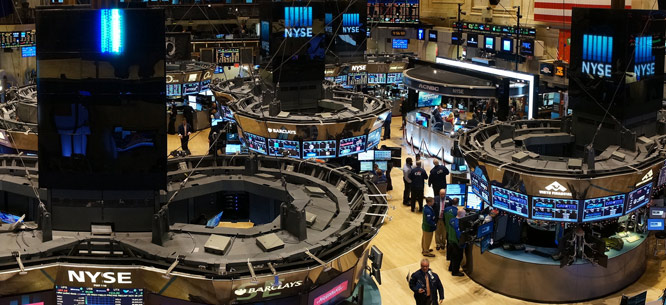
The floor of the New York Stock Exchange (RosieTulips / Flickr)
Many things have been said of the British public since the country’s vote to leave the EU. In the immediate aftermath, pundits were unsparing of the “ignorant” voters who, they insisted, had been conned into opting for Brexit. Yet the sternest response, judging from news reports, has come not from pundits but from the market. Just yesterday, the Bank of England cut interest rates to a record low in response to the sharpest drop in stock indexes since 2008. The headlines tell us that the global market, or the stock market, or the financial market, or the labor market, or perhaps all of these markets together have reacted and will continue to react to Brexit. And we are, or we should be, terrified.
This refrain is familiar, but also puzzling, because those reports never really explain what they mean, exactly, by “the market.” In some sense, we all know what we mean we talk about a market: a market is a place where you go to buy and sell things. They’ve existed for centuries; Fernand Braudel wrote of medieval markets filled with “piles of produce, slabs of butter, heaps of vegetables, pyramids of cheese, fruit, wet fish, game, meat which the butcher cut up on the spot, unsold books whose pages were used to wrap up purchases.” These markets met weekly or yearly, at the center of town, or on the outskirts; sometimes under cover, often not. They still do.
But when we talk about markets today, we mean something more grand and mysterious. The meaning of “market” has expanded to cover many aspects of our lives, and become more abstract in the process. As early as 1928, people started talking about a “marketplace of ideas.” By the 1970s, “the market” meant “the competitive free market; the operation of supply and demand;” in the same decade, historian Daniel Rodgers tells us, market metaphors became detached from history and institutions. The market had become a “metaphor for society as a whole.” In the 1980s, Ronald Reagan praised the “magic of the marketplace,” and by the 1990s, “the market” sounded like a democratic utopia.
Given how ordinary people use the term, it’s not surprising that academic economists are a little vague about it—but you’ll be glad to hear that they know they’re being vague. A generation of economists have criticized their colleagues’ inability to specify what a “market” actually is. George Stigler, back in 1967, thought it “a source of embarrassment that so little attention has been paid to the theory of markets.” Sociologists agree: according to Harrison White, there is no “neoclassical theory of the market—[only] a pure theory of exchange.” And Wayne Baker found that the idea of the market is “typically assumed—not studied” by most economists, who “implicitly characterize ‘market’ as a ‘featureless plane.’”
This is a long way from pyramids of cheese and slabs of butter. When we say “market” now, we mean nothing particularly specific, and, at the same time, everything—the entire economy, of course, but also our lives in general. If you can name it, there’s a market in it: housing, education, the law, dating. Maybe even love is “just an economy based on resource scarcity.”
The use of markets to describe everything is odd, because talking about “markets” doesn’t even help us understand how the economy works—let alone the rest of our lives. Even though nobody seems to know what it means, we use the metaphor freely, even unthinkingly. Let the market decide. The markets are volatile. The markets responded poorly. Obvious facts—that the economy hasn’t rebounded after the recession—are hidden or ignored, because “the market” is booming, and what is the economy other than “the market”? Well, it’s lots of other things. We might see that if we talked about it a bit differently.
For instance, we might choose a different metaphor—like, say, the traffic system. Sounds ridiculous? No more so than the market metaphor. After all, we already talk about one important aspect of economic life in terms of traffic: online activity. We could describe it in market terms (the market demands Trump memes!), but we use a different metaphor, because it’s just intuitively more suitable. That last Trump meme is generating a lot of traffic. Redirect your attention as required.
This is just one instance in which talking about traffic, rather than markets, makes more sense in light of our day–to-day lives. We don’t know much about markets, because we don’t deal with them very often. But most of us know plenty about traffic systems: drivers will know the frustration of trying to turn left onto a major road, of ceaseless, pointless lane-switching on a stalled rush-hour freeway, but also the joys of clear highways. Public transport users will feel the pain of canceled trains and overcrowded buses, but also the pleasure of being able to sit and read and daydream while being transported across the city. Anyone who’s ever flown has wondered why the process has to be so unpleasant, and should also have considered that at least the unpleasantness only lasts for a few hours, and not, as in the oceangoing ages, months.
We know the traffic system because, whether we like it or not, we are always involved in it, from birth: as soon as little Jean Doe leaves the hospital, s/he’ll never leave the transport system. If you step out of your door, you’re no longer just yourself; you’re a pedestrian, or a bicyclist, or on your way to another mode of transportation. And that’s how the economy works, too. Jean’s parents are just about to get a bill for the birthing process, and for the doctor’s appointments that came before it. In a month, they’ll buy formula (not that they advocate that sort of thing), and swaddle cloths, and bedding. As of birth, Jean is in the economy—even if s/he rarely goes to a market. You can’t not be an economic actor; you can’t not be part of the transport system.
Just as you’re always already in the traffic system and the economy, and just as you rely on it being there, you also can’t leave the economy, even if it screws you over. If someone engages in economically stupid behavior—let’s say, lending out huge amounts on mortgages that will never, ever be repaid—and you lose out (even though you borrow responsibly, if at all), you might be able to sue, but in all likelihood you won’t be able to do much of anything, even if you’re the United States government. Similarly, if some twit veers into oncoming traffic and causes a five-car pileup that traps you on the highway, Ms. Doe won’t be able to sue the twit. She has to sit there, in her car, until someone cleans up the mess.
Despite these fairly frequent inconveniences, though, Jean and his/her parents happily rely on the infrastructure that has been built up over generations. They really can’t get around without them. The bus picks Mr. Doe up at the same place every day. Ms. Doe knows that she can turn out of her driveway with confidence, and turn into the street, and that the next street will be there, and then another, and then another. You can have a pop-up market, and a market that only opens on Sundays, or only opens at Christmas—but that’s not the way traffic works. And that’s not the way the economy works, either. It has to be there when we need it, and it’s always there, even if we wish it weren’t.
Consider also the composition of the traffic system and the economy. A market, whatever else it is, is always essentially the same thing: a place where people can come together to buy and sell things. We could set up a market right now, with a few fences and a sign announcing that people could buy and sell. We don’t even really need the fences. A traffic system, however, is far more complex. To begin with, the system includes publicly and privately run elements: most cars are privately owned, as are most airlines. But in many countries there are still publicly owned trains, buses and trams, and those that aren’t publicly run are heavily subsidized. There are publicly owned airlines, too, of course. Bikes are usually private, but some cities provide public bikes. Pedestrians are entirely private. But all of these elements use publicly funded infrastructure: your privately owned car is of no use without roads, which are mostly publicly funded, and private toll-roads wouldn’t go anywhere if they weren’t embedded in the publicly-funded road network. This is a much better map of the economy than a market could ever be. Economic activity relies on private actors, public actors, and publicly funded private actors all working within the institutions and infrastructure that have been developed over the last few centuries.
Those institutions can be international (say, the Trans-Pacific Partnership). They can be national (any given state’s monetary system). They can be sub-national (different states have different laws). They can be local (there are very different ways of buying and selling in, say, Istanbul and Los Angeles). The traffic system is just as globalized as the economy (most obviously in air travel, but also shipping and rail) but it’s also localized and diverse: there are no rickshaws in Venice, no water taxis in Minnesota.
As anyone who’s ever traveled in a foreign city will know, those localized transport systems all rely on very different rules and norms. But at home, we can take for granted the many rules that have to be followed by everyone just so we can get to work: Mr. Doe’s bus driver has to follow the rules of the road, with its signs and signals, its lights and lane markers. A bus might indeed have a slightly different set of rules to follow than that of a private car—buses can and must stop at bus stops; they might have specially designated lanes during rush hour; and there are even special categories of buses. Americans, quaintly, stop traffic in each direction when a big yellow school bus drops the kids home from school.
These rules are an accepted, even valued, part of modern life. And their acceptance makes sense. After all, what would a deregulated transport system look like? Cars without roads, without speed limits, without traffic signals, without social conventions? You’d be free to go wherever you like, provided you could find a vehicle and a regular source of gas, which sounds great, until you imagine millions of people all trying to do it at the same time. That sounds more like the world of Mad Max, and all that autonomy starts to sound like an awful lot of pointless horror.
But we don’t have to think in those terms, because nobody has ever seriously suggested that the regulation of the traffic system undermines American freedom. In fact, the highway system has always been a symbol of American freedom, the space where you can flee your past and express your true self: why else did Kerouac and the Beats, Thelma and Louise, go on the road? They were all fleeing the oppressions of private life, and the freeways helped them do that—despite the fact that the highway system itself only exists thanks to government spending. A well-functioning, centrally planned, well-regulated traffic system isn’t just compatible with an idealization of individual freedom: it is the very foundation for a cherished individual freedom. And that’s why Americans can still get their kicks on Route 66.
If it would be odd—possibly pathological—to insist on absolute autonomy on the roads, it’s just as strange to evaluate traffic systems solely by their growth. When asked if the traffic in LA is improving, no one would cite higher numbers of cars driven or more miles of tarmac laid. We know that expansions of the transport system have consequences: Volkswagen executives try to fudge their emission tests; environmentalists try to offset the emissions of their plane travel. Meanwhile, when we talk in terms of GDP and the Dow, when we track the rise and fall of market indicators, growth is the only standard we know—making it easy to forget that the growth of the economy, with all of its environmental and social consequences, is not necessarily the same thing as the good of the economy.
If we don’t evaluate traffic systems based on their size, or their growth, how do we evaluate them? Mostly, by how well they help people get where they want to go. The market metaphor encourages us to think that all economic activity is motivated by the search for profit, and pursued in the same fashion everywhere. In a market, everyone’s desires are perfectly interchangeable. But, while everybody engages in the transport system, we have no difficulty remembering that we all want to go to different places, in different ways, at different times, at different speeds, for different reasons. You might prefer to drive, because it’s faster; I prefer the train, because it’s more comfortable. That’s a more appropriate way to think about the economy, too. Like the transport system, the economy is the necessary framework for us getting where we want to go—but we all use it in our own ways, for our own purposes.
Of course, not all of these choices and desires can be fulfilled. People travel for many reasons, yes, but they also refrain from traveling sometimes, because the traffic system makes certain types of travel much harder than they need to be. A young woman born in South-Central LA can’t get to grocery stores, schools, and jobs as easily as her (distant) cousin in Beverly Hills. It’s easier to move around most American cities by car than it is to travel by bus, so if you can’t afford a car, your options are limited. These different opportunities for travel have very real consequences. We know that living close to good schools and groceries matters, which is why housing prices are so tied to school districts. We know that if you can’t afford a car, and the public transport system doesn’t work well, you can’t travel to accept job opportunities. And we know that, in most cases, these failures are systematic. Nobody chooses to live with a bad transport system: there just is only one of them.
Thinking about traffic systems in terms of individual choices is, then, deeply problematic. The Does have never been able to demand into existence a new public transport line in a poor part of town—and the same goes for new miles of road to an unconnected exurb. It’s impossible to imagine that highway construction and deteriorating public transit systems are the result of individual choices or “natural” economic processes (we’re looking at you, DC Metro). Deciding how to improve the traffic system, how to expand people’s opportunities, is obviously a question of resource allocation and prioritization on a scale that private individuals—even traders—cannot influence on their own. That’s why government have not historically trusted the “magic of the markets” to produce better opportunities for transport. We intuitively understand that these decisions are made at the level of mass society and public policy. And, whether you like it or not, this is true for decisions about the economy as well.
Thinking of the economy in terms of the market—a featureless plane, with no entry or exit costs, little need for regulation, and equal opportunity for all—obscures this basic insight. And this underlying misconception creates a lot of problems: we’ve fetishized economic growth, we’ve come to distrust government regulation, and we imagine that the inequalities in our country, and our world, are natural or justified. If we imagine the economy otherwise—as a traffic system, for example—we see more clearly how the economy actually works. We see that our economic life looks a lot less like going to “market” for fun and profit than it does sitting in traffic on our morning commute, hoping against hope that we’ll get where we want to go, and on time.
J.D. Evans’s writing can be found in places like The Point, McSweeney’s Online Tendency, and Santa Monica Review.