FAIR USE NOTICE

FAIR USE NOTICE

A BEAR MARKET ECONOMICS BLOG

DEDICATED TO OCCUPY AND THE ECONOMIC REVOLUTION

OCCUPY THE MARKETPLACE

FOLLOW ME ON FACEBOOK

This site may contain copyrighted material the use of which has not always been specifically authorized by the copyright owner. We are making such material available in an effort to advance understanding of environmental, political, human rights, economic, democracy, scientific, and social justice issues, etc. we believe this constitutes a ‘fair use’ of any such copyrighted material as provided for in section 107 of the US Copyright Law.

In accordance with Title 17 U.S.C. Section 107, the material on this site is distributed without profit to those who have expressed a prior interest in receiving the included information for research and educational purposes. For more information go to: http://www.law.cornell.edu/uscode/17/107.shtml

If you wish to use copyrighted material from this site for purposes of your own that go beyond ‘fair use’, you must obtain permission from the copyright owner.

FAIR USE NOTICE FAIR USE NOTICE: This page may contain copyrighted material the use of which has not been specifically authorized by the copyright owner. This website distributes this material without profit to those who have expressed a prior interest in receiving the included information for scientific, research and educational purposes. We believe this constitutes a fair use of any such copyrighted material as provided for in 17 U.S.C § 107.

Read more at: http://www.etupdates.com/fair-use-notice/#.UpzWQRL3l5M | ET. Updates
FAIR USE NOTICE FAIR USE NOTICE: This page may contain copyrighted material the use of which has not been specifically authorized by the copyright owner. This website distributes this material without profit to those who have expressed a prior interest in receiving the included information for scientific, research and educational purposes. We believe this constitutes a fair use of any such copyrighted material as provided for in 17 U.S.C § 107.

Read more at: http://www.etupdates.com/fair-use-notice/#.UpzWQRL3l5M | ET. Updates

All Blogs licensed under Creative Commons Attribution 3.0

Tuesday, June 25, 2013

The Last Mystery of the Financial Crisis

Rolling Stone

POLITICS


The Last Mystery of the Financial Crisis

It's long been suspected that ratings agencies like Moody's and Standard & Poor's helped trigger the meltdown. A new trove of embarrassing documents shows how they did it


The Last Mystery of the Financial Crisis
Victor Juhasz
June 19, 2013 9:00 AM ET

What about the ratings agencies?

That's what "they" always say about the financial crisis and the teeming rat's nest of corruption it left behind. Everybody else got plenty of blame: the greed-fattened banks, the sleeping regulators, the unscrupulous mortgage hucksters like spray-tanned Countrywide ex-CEO Angelo Mozilo.

But what about the ratings agencies? Isn't it true that almost none of the fraud that's swallowed Wall Street in the past decade could have taken place without companies like Moody's and Standard & Poor's rubber-stamping it? Aren't they guilty, too?

Man, are they ever. And a lot more than even the least generous of us suspected.

Everything Is Rigged: The Biggest Price-Fixing Scandal Ever


Thanks to a mountain of evidence gathered for a pair of major lawsuits by the San Diego-based law firm Robbins Geller Rudman & Dowd, documents that for the most part have never been seen by the general public, we now know that the nation's two top ratings companies, Moody's and S&P, have for many years been shameless tools for the banks, willing to give just about anything a high rating in exchange for cash.

In incriminating e-mail after incriminating e-mail, executives and analysts from these companies are caught admitting their entire business model is crooked.
"Lord help our fucking scam . . . this has to be the stupidest place I have worked at," writes one Standard & Poor's executive. "As you know, I had difficulties explaining 'HOW' we got to those numbers since there is no science behind it," confesses a high-ranking S&P analyst. "If we are just going to make it up in order to rate deals, then quants [quantitative analysts] are of precious little value," complains another senior S&P man. "Let's hope we are all wealthy and retired by the time this house of card[s] falters," ruminates one more.

Ratings agencies are the glue that ostensibly holds the entire financial industry together. These gigantic companies – also known as Nationally Recognized Statistical Rating Organizations, or NRSROs – have teams of examiners who analyze companies, cities, towns, countries, mortgage borrowers, anybody or anything that takes on debt or creates an investment vehicle.

Their primary function is to help define what's safe to buy, and what isn't. A triple-A rating is to the financial world what the USDA seal of approval is to a meat-eater, or virginity is to a Catholic. It's supposed to be sacrosanct, inviolable: According to Moody's own reports, AAA investments "should survive the equivalent of the U.S. Great Depression."

The Scam Wall Street Learned From the Mafia


It's not a stretch to say the whole financial industry revolves around the compass point of the absolutely safe AAA rating. But the financial crisis happened because AAA ratings stopped being something that had to be earned and turned into something that could be paid for.

That this happened is even more amazing because these companies naturally have powerful leverage over their clients, as they are part of a quasi-protected industry that enjoys massive de facto state subsidies. Largely that's because government agencies like the Securities and Exchange Commission often force private companies to fulfill regulatory requirements by retaining or keeping in reserve certain fixed quantities of assets – bonds, securities, whatever – that have been rated highly by a "Nationally Recognized" ratings agency, like the "Big Three" of Moody's, S&P and Fitch. So while they're not quite part of the official regulatory infrastructure, they might as well be.

It's not like the iniquity of the ratings agencies had gone completely unnoticed before. The Financial Crisis Inquiry Commission published a case study in 2011 of Moody's in particular and discovered that between 2000 and 2007, the agency gave nearly 45,000 mortgage-backed securities AAA ratings. One year Moody's doled out AAA ratings to 30 mortgage-backed securities every day, 83 percent of which were ultimately downgraded. "This crisis could not have happened without the rating agencies," the commission concluded.

Thanks to these documents, we now know how that happened. And showing as they do the back-and-forth between the country's top ratings agencies and one of America's biggest investment banks (Morgan Stanley) in advance of two major subprime deals, they also lay out in detail the evolution of the industrywide fraud that led to implosion of the world economy – how banks, hedge funds, mortgage lenders and ratings agencies, working at an extraordinary level of cooperation, teamed up to disguise and then sell near-worthless loans as AAA securities. It's the black box in the American financial airplane.

In April, Moody's and Standard & Poor's settled the lawsuits for a reported $225 million. Brought by a diverse group of institutional plaintiffs with King County, Washington, and the Abu Dhabi Commercial Bank taking the lead, the suits accused the ratings agencies of conspiring in the mid-to-late 2000s with Morgan Stanley to fraudulently induce heavy investment into a pair of doomed-to-implode subprime-laden deals, called Cheyne and Rhinebridge.

Stock prices for both companies soared at the settlement, with markets believing the firms would be spared the hell of reams of embarrassing evidence thrust into public view at trial. But in a quirk, an earlier judge's ruling had already made most of the documents in the case public. Although a few news outlets, including The New York Times, took note at the time, the vast majority of the material was never reported, and some was never seen by reporters at all. The cases revolved around a highly exotic and complex financial instrument called a SIV, or structured investment vehicle.

The SIV is a not-so-distant cousin of the special purpose entity, or SPE, which was the main weapon of destruction in the Enron scandal. The corporate scam du jour in those days was mass accounting fraud, in which a company would create an ostensibly independent corporate structure that would actually be controlled by its own executives, who would then move their company's liabilities off their own books and onto the remote-controlled SPE, hiding the firm's losses.

The SIV is a similar concept. They first started showing up in the late Eighties after banks discovered a loophole in international banking standards that allowed them to create SPE-like repositories full of assets like mortgage-backed securities and keep them off their own books.

These behemoths operated on the same basic concept as an ordinary bank, which borrows short-term cash from depositors and then lends money long-term in the form of things like mortgages, business loans, etc. The SIV did the same thing, borrowing short-term from investors and then investing long-term on things like student loans, car loans, subprime mortgages. Like banks, a SIV made money on the spread between its short-term debt and long-term investments. If a SIV borrowed on the commercial paper market at 3 percent but earned 6.5 percent on subprime mortgages, that was an easy 3.5 percent profit.

The big difference is a bank has regulatory capital requirements. A SIV doesn't, and being technically independent, its potential liabilities don't show up on the books of the megabank that created it. So the SIV structure allowed investment banks to create and take advantage of, without risk, billions of dollars of things like subprime loans, which became the centerpiece of the new trendy corporate scam – creating and then selling masses of risky mortgage-backed securities as AAA investments to institutional suckers.


Ratings agencies helped this game along in two ways. First, banks needed them to sign off on the bogus math of the subprime era – the math that allowed banks to turn pools of home loans belonging to people so broke they couldn't even afford down payments into securities with higher credit ratings than corporations with billions of dollars in assets. But banks also needed the ratings agencies to sign off on the safety and reliability of these off-balance-sheet SIV structures.

The first of the two SIVs in question was dreamed up by a London-based hedge fund called Cheyne Capital Management (pronounced like Dick "Cheney"), run by an ex-Morgan Stanley banker duo who hired their old firm to build and stock this vast floating Death Star of subprime loans.

Morgan Stanley had multiple motives for putting together the Cheyne deal. For one thing, it earned what the bank's lead structurer affectionately called "big fat upfront fees," which bank executives estimated would eventually add up to $25 million or $30 million. It was a lucrative business, and the top dogs wanted the deal badly. "I am very focused on . . . getting this deal done to get NY to stop freaking out" and "to make our money," said Robert Rooney, the senior Morgan Stanley executive on the deal. A spokesman for Morgan Stanley, however, told Rolling Stone, "Our sole economic interest was in the ongoing success of the SIV."

But that wasn't Morgan Stanley's only motive. Not only could the bank make the "big fat upfront fees" for structuring the deal, they could also turn around and sell scads of their own mortgage-backed securities to the SIV, which in turn would be marketed to investors like Abu Dhabi and King County. In Cheyne, 25 percent of the original assets in the deal came from Morgan Stanley – over time, $2 billion of the SIV's $9 billion to $10 billion portfolio of assets came from the bank as well.

Internal Morgan Stanley memorandums show that the bank knowingly stuffed mortgages in the SIV whose borrowers were, to say the least, highly suspect. "The real issue is that the loan requests do not make sense," complained a Morgan Stanley employee back in 2005. He noted loans had been made to a "tarot reading house" operator who claimed to make $12,000 a month, and a "knock off gold club distributor" who claimed to make $16,000 a month. "Compound these issues," he groaned, "with the fact that we are seeing what I would call a lot of this type of profile."

No matter – into the soup it went! Morgan sold mountains of this crap into Cheyne's SIV, where it was destined to be sold off to other suckers down the line. The only thing that could possibly get in the way of the scam was some pesky ratings agency.

Fortunately for the bank and the hedge fund, these subprime SIVs were a relatively new kind of investment product, so the ratings agencies had little to go on in the area of historical data to measure these products. One might think this would make the ratings agencies more conservative. In fact, caution in the face of the unknown was supposed to be a core value for these companies. As Moody's put it, "Triple-A structures should not be highly dependent on untestable assumptions."

But when it came to the Cheyne SIV, Moody's punted on caution. In an e-mail sent to executives from both Morgan Stanley and Cheyne in May 2005, David Rosa, a Moody's senior analyst, admitted that when it came to this SIV, he had nothing to go on.

"Please note that in relation to assumed spread [volatility] for the Aa and A there is no actual data backing up the current model assumptions," he wrote. In lieu of such data, he went on, "We will for now accept the proposal to use the same levels as [residential mortgage-backed securities] given that this assumption is supported by the analysis of the Aaa data . . . and Cheyne's comments on their views of this asset class."

Translation: We have no historical data, so we'll just accept your reasoning for the time being, even though you have every incentive in the world to lie about the quality of your product.

At one point, a Morgan Stanley analyst even claimed that the bank had written, in Moody's name, an entire 12-page "New Issue Report" for the Cheyne SIV – a kind of ratings summary in which Morgan Stanley appears to have given itself AAA ratings for large chunks of the deal. "I attach the Moody's NIR (that we ended up writing)," yawns Morgan Stanley fixed-income employee Rany Moubarak in a March 2006 e-mail. The attached document came proudly affixed with the "Moody's Investors Service" logo. (Both Moody's and Morgan Stanley deny that anyone other than Moody's wrote that report.)

Morgan Stanley ended up getting both Moody's and S&P to rate the deal, and that was not only common, it was basically industry practice. There were many reasons for this, but a big one was a concept called "notching," in which the agencies gave ratings penalties to any instrument that had not been rated by their own company. If a SIV contained a basket of mortgage-backed securities rated AA by Standard & Poor's, Moody's might "notch" those underlying securities down to A, or even lower. This incentivized the banks to hire as many ratings agencies as possible to rate every investment vehicle they created.

Again, despite the fact that the ratings agencies enjoyed broad quasi-official subsidies, and despite the powerful market leverage that techniques like "notching" gave them, they still routinely chose to roll over for banks. And the biggest companies were equally guilty. In the case of the Cheyne deal, Standard & Poor's was every bit as craven as Moody's.

In September 2004, an S&P analyst named Lapo Guadagnuolo sent an e-mail to Stephen McCabe, the agency's lead "quant" on the Cheyne deal, who apparently was on vacation. The e-mail chain was mostly a bunch of office gossip, where the two men e-whispered about an employee who was about to quit. But sandwiched in the office banter was an offhand line about the Cheyne deal and how full of shit it was. "Hi Steve!" Guadagnuolo wrote cheerily, adding, "How is Australia and how was Thailand????Back to [Cheyne] . . . As you know, I had difficulties explaining 'HOW' we got to those numbers since there is no science behind it . . .

"Thanks and regards . . . have you heard that [redacted] has resigned . . . and somebody else will follow suit today!!"

McCabe, blowing off the "no science behind it" comment, answered eagerly, "Who, Who, Who????" The quadruple question mark must be an S&P-ism.
A month later, McCabe seemed more concerned about the lack of science in the Cheyne deal. He complained in an e-mail to his boss, Kai Gilkes, who was the agency's senior quantitative analyst in Europe.

"From looking at the numbers it is quite obvious that we have just stuck our preverbal [sic] finger in the air!!" he fumed.

Gilkes was experiencing his own crisis of conscience by mid-2005, complaining in an oddly wistful e-mail to another S&P employee that the good old days of just giving things the ratings they deserved were disappearing. "Remember the dream of being able to defend the model with sound empirical research?" he wrote on June 17th, 2005. "If we are just going to make it up in order to rate deals, then quants are of precious little value."

Frank Parisi, Standard & Poor's chief credit officer for structured finance, was even more downtrodden, saying that the model that his company used to rate residential mortgage-backed securities in 2005 and 2006 was only marginally more accurate than "if you just simply flipped a coin."

Given all of this, why would top analysts from both Moody's and Standard & Poor's rate such a massive deal like Cheyne without any science to back it up? The answer was simple: money. In the old days, ratings agencies lived on subscriptions sold to investors, meaning they were compensated – indirectly, incidentally – by the people buying the financial products.

But over time, that model morphed into the current "issuer pays" model, in which a company like Moody's or Standard & Poor's is paid directly by the "issuer" – i.e., the company that is actually making the financial product.
For Cheyne, for instance, the agencies were paid in the area of $1 million to $1.5 million to rate the deal by Morgan Stanley, the very company with an interest in getting a high rating. It's the ultimate in negative incentives, and was and continues to be a major impediment to honest analysis on Wall Street. Michigan Sen. Carl Levin, one of the few lawmakers to focus on reforming the ratings agencies after the crash, put it this way: "It's like one of the parties in court paying the judge's salary."

Thanks to this model, ratings-agency business soared during the bubble era. A Senate report found that fees for the "Big Three" doubled between 2002 and 2007, from $3 billion to $6 billion. Fees for rating mortgage-backed securities at both Moody's and S&P nearly quadrupled.

So there were powerful incentives to whitewash deals like Cheyne. The eventual president of Moody's, Brian Clarkson, actually copped to this awful truth in writing, in a 2004 internal e-mail. "To put it bluntly," he wrote, "the issuer could take its business elsewhere unless the rating agency provides a higher rating."

Both Moody's and Standard & Poor's employees described complex/exotic new financial products like CDOs and SIVs as "cash cows," and behind closed doors, executives talked openly about the financial pressure to give scientifically unfounded analysis to products the banks wanted to sell.

The minutes from a 2007 conference of Standard & Poor's executives show that the raters knew they were in way over their heads. Admitting that it was virtually impossible to accurately rate, say, a synthetic derivative loan deal with underlying assets in China and Russia, one executive candidly admits, "We do not have the capacity nor the skills in house to rate something like this." Another counters, "Market pressures have significantly risen due to 'hot money.'" The first retorts that bankers are pushing boundaries, asking the raters to help them play the highly cynical hot-potato game, in which bad loans are originated en masse and then instantly passed off to suckers who will take on all the risk. "Bankers say why not originate bad loans, there is no penalty," the executive muses.

Hilariously – or tragically, depending on your point of view – an S&P executive at the conference even tossed off a quick visual sketch of their company's moral quandary. The picture is atrociously drawn (it looks like a junior high school student's rendering of a ganglion cell) and comes across like the Wall Street version of Hamlet, showing the industry traveling down a road and reaching a "Choice Point" crossroads, where the two options are "To Rate" and "Not Rate."

The former – basically taking the money and just rating whatever crap the banks toss their way – is crudely depicted as a wide, "well marked super highway." Meanwhile the honorable thing, not rating shitty investments, is shown to be a skinny little roadlet, marked "Dark and narrow path less traveled."

Obviously, the ratings agencies like S&P ultimately decided to take the road more traveled, choosing profits over scruples. Not that there wasn't some token resistance at first. For instance, some at S&P hesitated to allow the use of a questionable technique called "grandfathering," in which old and outdated rating models were used to rate newly issued investments.

In one damning e-mail chain in November 2005, a Morgan Stanley banker complains to an S&P executive named Elwyn Wong that S&P was preventing him from putting S&P ratings on Morgan Stanley deals that used this grandfathering technique. "My business is on 'pause' right now," the banker complains.

Wong took the news that S&P was holding up deals over the grandfathering issue badly. "Lord help our fucking scam," he said. "This has to be the stupidest place I have worked at." Wong, incidentally, was later hired by the U.S. Office of the Comptroller Currency, our top federal banking regulator.

The purists, however, couldn't hold out for long. In the Cheyne case, when one of the "quants" tried to hold the line, Morgan Stanley went over their heads to someone on the business side at the company to get the rating it wanted.
In July 2004, for instance, analyst Lapo Guadagnuolo sent an e-mail to Morgan Stanley's point man on the Cheyne deal, Gregg Drennan, and told him that the best he could do for the "mezzanine capital notes" or "MCN" piece of the SIV – a piece that Drennan wanted at least an A rating for – was BBB-plus. Drennan responded in an e-mail that CC'd Guadagnuolo's boss, Perry Inglis, telling him that Morgan Stanley "believe[s] the position the committee is taking is very inappropriate."

Ultimately, the analyst committee agreed to give the dubious Mezzanine Notes an A rating, marking the first time these middle-tier investments in a SIV ever received a public A rating. For Wall Street, this was occasion to par-tay. In the summer of 2005, one of the Cheyne hedge-funders sent out a celebratory e-mail to Morgan Stanley execs, bragging about getting the ratings companies to cave. "It is an amazing set of feats to move the rating agencies so far," the hedgie wrote. "We all do all this for one thing and I hope promotions are a given. Let's hope big bonuses are to follow."

Later on, S&P caved even further, agreeing to allow Morgan Stanley to lower the "capital buffer" in the deal protecting investors without suffering a ratings penalty. As late as February 1st, 2006, Guadagnuolo was defiantly telling Morgan Stanley that the one-percent buffer was a "pillar of our analysis." But by the next day, Morgan Stanley executive Moubarak had chopped Guadagnuolo's knees out. He cheerfully announced in a group e-mail that the bank had managed to remove this "pillar" and get the buffer knocked down to .75 percent.

Tina Sprinz, who worked for the Cheyne hedge fund, sent an e-mail that very day to Moubarak, thanking him for straightening out the pesky analysts. "Thanks for negotiating that," she says. The ratings process shouldn't be a "negotiation," yet this word appears throughout these documents.

In the Cheyne deal, just the plaintiffs in the lawsuit invested a total of $980 million in "rated notes," and those who invested in these "MCNs" were completely wiped out. Analysts from both agencies would express regret and/or trepidation about their roles in unleashing the monster deals and their failure to stop the business-side suits running the companies from selling them out. Gilkes, the S&P analyst who worried about shunning real science in favor of just making things up, later testified that the subprime assets in such SIVs were "not appropriate."

"They should not have been rated," he said.

If the significance of Cheyne is that it showed how the ratings agencies sold out in an effort to get business, the significance of the next deal, Rhinebridge, is that it showed how low they were willing to stoop to keep that business.

Rhinebridge was a subprime-packed SIV structured very much like Cheyne, only both the quality of the underlying crap in the SIV and the timing of the SIV's launch were significantly more horrible than even Cheyne's.

Not only did Morgan Stanley insist that the ratings agencies allow the bank to pack Rhinebridge full of a much higher quantity of subprime than in the Cheyne deal, they were also pushing this massive blob of toxic mortgages at a time when the subprime market was already approaching full collapse.

In fact, the Rhinebridge deal would launch with high ratings from both agencies on June 27th, 2007, less than two weeks before both Moody's and S&P would downgrade hundreds of subprime mortgage-backed securities. In other words, both Moody's and S&P were almost certainly in the process of downgrading the underlying assets in the Rhinebridge SIV even as they were preparing to launch Rhinebridge with AAA-rated notes.

"It was the briefest AAA rating in history," says the plaintiffs' lawyer Dan Drosman. "Rhinebridge went from AAA to junk in a matter of months."
There is an enormous documentary record in both agencies showing that analysts and executives knew a bust was coming long before they sent Rhinebridge out into the world with a AAA label. As early as 2005, S&P was talking in internal memorandums about a "bubble" in the real-estate markets, and in 2006 it knew that there had been "rampant appraisal and underwriting fraud for quite some time," causing "rising delinquencies" and "nightmare mortgages."

In June 2007, the same month Rhinebridge was launched, S&P's Board of Directors Report talked about a total collapse of the market. "The meltdown of the subprime-mortgage market will increase both foreclosures and the overhang of homes for sale."

It was no better at Moody's, where in June 2007, executives were internally discussing "increased amounts of lying on income" and "increased amounts of occupancy misstatements" in mortgage applications. Clarkson, who would become president two months later, was told the week before Rhinebridge launched that "most players in the market" believed subprime would "perform extremely poorly," and that the problems were "quite serious."

Yet the two ratings agencies not only kept those concerns private, they both took outlandish steps to declare just the opposite.

In a pair of matching public papers, both Moody's and S&P proclaimed that summer that while subprime might be going to hell, subprime-packed investments like SIVs might be just fine. The Moody's report on July 18th read "SIVs: An Oasis of Calm in the Sub-prime Maelstrom," while an S&P report on August 14th, 2007, was titled "Report Says SIV Ratings Are Weathering Current Market Disruptions."

The S&P report was so brazen that it even shocked a Morgan Stanley banker involved in the SIV deals. "I cannot believe these morons would reaffirm in this market," chortled the banker in an e-mail the day after the paper was released.

Rhinebridge, cheyne and a hell of a lot of other subprime investments ultimately blew to smithereens, taking with them vast amounts of cash – 40 percent of the world's wealth was wiped out in the aftermath of the mortgage bubble, according to some estimates. 2008 was to the American economy what 9/11 was to national security. Yet while 9/11 prompted the U.S. government to tear up half the Constitution in the name of public safety, after 2008, authorities went in the other direction. If you can imagine a post-9/11 scenario where there were no metal detectors at airports and people could walk on carrying chain saws and meat cleavers, you get a rough idea of what was done to reform the ratings process.

Specifically, very little was done to change the way AAA ratings are created – the "issuer pays" model still exists, and the "Big Three" retain roughly the same market share. An effort by Minnesota Sen. Al Franken to change the compensation model through a new approach under which agencies would be assigned to rate new issues through a government agency passed overwhelmingly in the Senate, but in the House it was relegated to a study by the SEC – which released its findings last year, calling for . . . more study. "The conflict of interest still exists in the exact same way," says a frustrated Franken.

The companies by now are all the way back in black. In 2012, for instance, Moody's profits soared 22 percent, to $1.18 billion. McGraw-Hill, the parent company of Standard & Poor's, scored $437 million in profits last year, with the rating business accounting for 70 percent of the company's profits.

In February, the Obama Justice Department, in an action that seems belated, filed a $5 billion civil suit against Standard & Poor's, drawing upon some of the same data and documents that were part of the Cheyne and Rhinebridge suits. As part of that action, high-ranking officials at S&P were interviewed by government investigators and admitted that they had shaded their ratings methodologies to protect market share. In this deposition of Richard Gugliada, head of S&P's CDO operations, the government asks why the company was slow to implement updates to its model for evaluating CDOs:

Q: Is it fair to say that Standard & Poor's goal of preserving an increasing market share and profits from ratings fees influence the development of the updates to the CDO evaluator?

A: In part, correct.

Q: The main reason to avoid a reduction in the noninvestment grade ratings business was to preserve S&P's market share in that category, correct?

A: Correct.

Years after the crash, it's a little insulting to see industry analysts blithely copping under oath to having traded science for market share, especially since the companies continue to protest to the contrary in public. Contacted for this story, Moody's and S&P insisted many of the documents in this case were simply taken out of context, and that their analysis throughout has been rigorous, objective and independent.

It's a thin defense, but it's holding – for now. McGraw-Hill stock plunged nearly 14 percent when news of the Justice Department suit leaked, and dropped nearly 19 percent for February, but has since regained much of its value – its stock rose nearly 16 percent in March and April, as markets reacted favorably to, among other things, its recent settlement of the Cheyne and Rhinebridge suits. The markets clearly think the ratings agencies will survive.

What's amazing about this is that even without a mass of ugly documentary evidence proving their incompetence and corruption, these firms ought to be out of business. Even if they just accidentally sucked this badly, that should be enough to persuade the markets to look to a different model, different companies, different ratings methodologies.

But we know now that it was no accident. What happened to the ratings agencies during the financial crisis, and what is likely still happening within their walls, is a phenomenon as old as business itself. Given a choice between money and integrity, they took the money. Which wouldn't be quite so bad if they weren't in the integrity business.

This story is from the July 4 - July 18, 2013 issue of Rolling Stone

Monday, June 24, 2013

6 Facts About Hunger That Demonstrate the Shameful Excesses of American Capitalism


Hard Times USA  


Children, seniors and disabled citizens going hungry is a stain on humanity.


Photo Credit: Wikimedia
 
 
Of all the miseries placed on human beings in their everyday lives, the lack of food may be the most inexcusable. Even in a world controlled by unbending attitudes of self-reliance and individual responsibility, the reality of children and seniors and disabled citizens going hungry is a stain on humanity, a shameful testament to the capitalist goal of profit without conscience.

The facts presented here all touch on the lives of human beings, in the U.S. and beyond, who lack food or the means to pay for it.

1. Congress wants to cut a food program that feeds low-income children.
According to the Department of Agriculture, 48% of Supplemental Nutrition Assistance Program (SNAP) recipients in 2011 were children. Either unaware or indifferent to this, Congress is considering a new farm bill that would cut food assistance by $2 billion a year while boosting the farm subsidies of big agriculture.

2. Some individuals make enough in two seconds to pay a SNAP recipient's food bill for an entire year.

Americans Bill Gates, Warren Buffett, Larry Ellison, two Kochs, and four Waltons made an average of $6 billion each from their stocks and other investments in 2012. A $6 billion per year person makes enough in two seconds (based on a 40-hour work-week) to pay a year's worth of benefits to the average SNAP recipient. Just 20 Americans made as much from their 2012 investments as the entire SNAP budget for 47 million people.

Capitalism encourages an individual to make as much money as possible, even without producing anything. Most Americans accept that. But questions should be raised about a system that allows the yearlong needs of a hungry person to flash by in two seconds of an investor's life.

3. McDonald's profits are double the total wages of all its food servers.
McDonald's has 440,000 employees, most of them food servers making the median hourly wage of $9.10 an hour or less, for a maximum of about $18,200 per year. The company's $8 billion profit, after wages are paid, works out to the same amount: $18,200 per employee.

As noted by MSN Money, the company pays its front-line workers minimum wage or very close to it. But instead of passing along part of its profits to employees, McDonald's just announced plans for increased dividends and share repurchases.

4. Just 10 individuals made as much as all the fast-food counter workers in the U.S.

The 10 richest on the Forbes list increased their combined wealth by almost $60 billion from 2011 to 2012. That's approximately equivalent to the total annual salaries of 3,378,030 fast-food counter employees if they were all able to work 40-hour weeks, 50 weeks a year.

5. Apple avoided enough in taxes to mount a global attack on malnutrition.
The World Bank estimates the total cost for "successfully mounting an attack on malnutrition" would be about $10.3 to $11.8 billion annually. Apple alone underpaid its 2012 taxes by $11 billion, based on a 35% rate on total global income. (The company paid $8,443 current taxes on $55,763 total income, or a little over 15%.)

6. Speculation on food prices has contributed to the impoverishment of 115 million people.

From 1996 to 2011 the portion of speculative wheat market trades by Goldman Sachs and other players went from 12 percent to 61 percent. The price of wheat went from $105 a ton in 2000 to $481 a ton in 2008.

Food prices dropped after the recession, but the World Bank notes that they've jumped 43 percent since 2010. The World Food Program reported that since 2008, high prices have pushed 115 million more people into hunger and poverty.

Speculation hasn't hurt the speculators. According to the World Wealth Report 2013, the number of high net worth individuals ($1 million or more in investable assets) increased by 11.5% in North America in 2012, the highest rate in the world.

Billionaires are on the rise, and a billion people are without adequate food. The speculators should be ashamed.

7 Institutions That Have Grown So Monstrously Big They Threaten to Destroy America


Economy  


With power increasingly corrupted by ever-bigger forces, who will speak for the individual citizens of this country?


Bigger isn’t always better. From the Tower of Babel to Teddy Roosevelt’s trust-busting, that principle’s been enshrined in law and legend since the dawn of history. Have we forgotten the lesson?

Corporations, databases, storehouses of personal and institutional wealth all are expanding at ever-increasing speed, threatening to engulf our economy and our lives as they do. That’s the problem with Big Things: Once they reached a certain size, they keep on getting bigger.

Here are seven ways the runaway power of Bigger in finance and in data is threatening to overwhelm us all.

1. Bigger Corporations


Americans have known about the danger of overly large corporations since the founding of the Republic. “I hope that we shall crush in its birth the aristocracy of our monied corporations,” said Thomas Jefferson, “which dare already to challenge our government to a trial of strength, and bid defiance to the laws of our country.”

“The money powers prey upon the nation in times of peace and conspire against it in times of adversity,” Abraham Lincoln observed. “The banking powers are more despotic than a monarchy, more insolent than autocracy, more selfish than bureaucracy.”

Even an unlikely populist, Grover Cleveland, said this: “As we view the achievements of aggregated capital, we discover the existence of trusts, combinations, and monopolies, while the citizen is struggling far in the rear, or is trampled beneath an iron heel. Corporations, which should be the carefully restrained creatures of the law and the servants of the people, are fast becoming the people’s masters.”

Oversized corporate power is why Congress passed the Sherman Antitrust Act of 1890. It’s why Theodore Roosevelt broke up the railroad. When businesses become so large that competition’s squeezed out, everybody suffers.

And yet today we’re confronted with the largest corporations in history, with predictable, even inevitable, results. In real dollar terms, the minimum wage is less than half what it was in 1968. One of the main reasons for that is that most minimum-wage employees work for large corporations who dominate both their labor markets and the political process.

The Census Bureau reported in 2008 that 33 million Americans—more than 25 percent of the total workforce—worked for corporations with 10,000 employees or more. The largest employer is Walmart, with an astonishing 1,400,000 employees, followed by the company that owns Taco Bell, Pizza Hut and KFC, and then McDonald's.

With that kind of clout it’s easy to keep wages low while doling out record payouts to executives and shareholders. Walmart, for example, paid $11.3 billion in dividends and share buybacks last year. That comes to more than $8,000 per worker. McDonald’s shareholder payouts came to nearly $7,000 per worker.

What’s more, despite their PR campaigns, there’s no evidence that shoppers benefit by paying less for their goods. Walmart aggressively forces prices downward for its suppliers, sometimes below the cost of production. But the suppliers have to make up the difference somewhere, either by over-charging other stores or underpaying their own employees and suppliers.

Either way, it comes out of the public’s pocket in the end.

Companies like Walmart don’t create jobs, either. They take them from elsewhere, and frequently pay less in wages. A Pennsylvania study found a correlation between the presence of Walmart and increases in county-wide poverty, which the authors speculated might have been because “Walmart stores destroy civic capacity in the communities in which they locate by driving out local entrepreneurs and community leaders.”

They can kill leadership at the national level, too.

2. Bigger Banks


The statistics on too-big-to-fail banks and financial institutions are staggering: The largest 0.2 percent of US banks—12 of them, altogether—control 69 percent of the industry’s total assets, while 98.6 percent of all banks held only 12 percent of assets.

The four biggest banks still control 83 percent of the derivatives market, and only 25 commercial banks—out of a total of 8,430 FDIC-insured commercial banks in the United States—control roughly 90 percent of the market.

With the exception of struggling Bank of America, the top five banks all grew even more in the first quarter of this year. Richard Fisher, president of the Dallas Federal Reserve Bank, co-authored a plan to address the unfair advantage these banks receive because everybody knows the government won’t let them fail.

And while the mega-banks tell us that customers can benefit from their “economies of scale,” customers have not seen lower rates or charges as the result of their extraordinary consolidation.

These banks are holding the economy and the public hostage to their own possible failure. That’s why they—and the bankers who work for them—were publicly notified by the Attorney General of the United States that they needn’t fear prosecution for their crimes. He later tried to walk that statement back, but he had only articulated a policy that had long been obvious among observers and lawmakers.

Our largest banks are becoming bigger than the law.

3. Bigger Investors


Holding companies, hedge funds, and other institutions own more and more of the private-sector economy. That includes groups like Mitt Romney’s Bain Capital, which invests in everything from pharmacies to retail chains to homes for troubled teens.

Edward Snowden’s revelations about the NSA lifted the veil of secrecy surrounding government contractors like his last employer, Booz Allen Hamilton, which is owned by a holding company called the Carlyle Group. Booz Allen brought the Carlyle Group $5.9 billion in revenue last year. In a classic example of Bigger in action, it also announced a new national security deal in February worth $11 billion.

Mega-investors like Bain Capital and the Carlyle Group aren’t like entrepreneurs or investors of the past, who put money and effort into businesses they believed in and then built them to last. They want their payouts on the shortest possible timeline, so they push executives at the companies they own to make the bottom line look as good as possible.

Sometimes that means sacrificing the long-term good of the company for a fast-buck payout to these holding companies. That may be one of the reasons why so many American corporations are giving out so much in dividends and share buybacks, rather than investing in infrastructure and employees.
When investors get Bigger, they insist on getting paid Faster.

4. Bigger Charities


It should be no surprise that all of this, along with government policies toward taxation and other matters, is creating runaway levels of individual wealth. And as a few individuals amass extraordinary wealth, even charitable giving becomes a bigger problem.

The philanthropic world is now dominated by a few players. The Bill and Melinda Gates Foundation is the mega-player, with more than $34 billion in assets. That’s more than the next three foundations combined. As of 2011, the top five foundations held nearly one-third as much in assets as the top 100 foundations put together. As foundations and other philanthropies expand, charitable organizations which are outside their funding protocols are less and less likely to receive funds.

Some players get Bigger within a niche. New York’s Robin Hood Foundation, originally funded by hedge fund donors, was given a great deal of authority over small donors’ funds to aid the region’s victims of Hurricane Sandy. Like similar foundations, Robin Hood has occasionally been used as a propaganda tool for arguing that government “can’t do the job.”

That’s not charity. That’s ideology.

Using aggressive sales tactics and rough elbows, the Susan G. Komen Race for the Cure came to dominate the breast cancer charity world. It became controversial after suing other charities that used some of the same phrases or symbols, even when they would have seemed to be in the public domain. (The word “cure” and the color pink were the subjects of two such lawsuits.)
The Komen group then abruptly defunded Planned Parenthood and other service groups, seemingly for political reasons. The resulting controversy helped the debate in one very real sense: it provided an object lesson in the dangers of Bigger, even in the world of charity.

5. Bigger Corporate Data


The recent NSA scandals have revealed the dangers of Bigger Data. But that phenomenon’s closely linked to Bigger’s other areas of overgrowth, especially in finance and investment. The scandal and controversy surrounding Facebook’s IPO (initial public offering) offered a glimpse into the intersection of Mega-Banks, Mega-Investors, and Mega-Data.

Every large enterprise is now pursuing bigger data. A new private study suggests that there continue to be fewer corporate data centers in the United States, but that each is correspondingly larger. Highly centralized databases leave businesses, economies and societies more vulnerable to disruptions caused by accidents, natural disasters, or acts of terror.

The Big Data vendors include Twitter, Facebook and Google. But they also include niche forms of Big Data, like banking. Newly launched banking investigations involve something called "dark pools," an alternative form of trading that takes place outside the normal stock markets. There is now evidence that the banks and service companies whose data platforms provide this service have been "front-running" trades, using customer information from their data systems to enrich themselves.

Even news organizations are entering the data-selling business. For $2,000 a month, Thomson Reuters offers a service called “ultra-low latency” which gives subscribers access to key economic reports two seconds before they’re released to the public. As Business Insider notes, “two seconds in … trading time is an eternity.” That’s because stock markets are computerized Big Data operations, too, and transactions can occur at nearly light-speed.

Big Data corporations are typically currently valued well in excess of what its real revenues would suggest. That’s certainly true of Facebook, because the world of Bigger believes in the power of data—and Facebook has it.

Most Facebook users would probably say that its interface is hard to use. Its founders aren’t wealthy because they’re brilliant programmers. They’re not visionaries, either. They thought they were creating a relatively small set of social networks for colleges. But they stumbled onto something powerful—the power of data that users volunteered about themselves—and they exploited it aggressively before anyone else could compete with them.

That’s how the world of Bigger works. You don’t need to be the best. You need to be the first. Then you need to be aggressive in order to stay the biggest. The forces of Bigger will do the rest.

6. Bigger Government Data


Mega-data is changing our government, too. The Obama administration’s “Big Data Initiative” suggests a mentality which believes Big Data is more useful than other forms of information.

Big Data has already created a national security apparatus of staggering proportions, as Dana Priest and William Arkin reported for the Washington Post. Large databases can provide enormously useful information, but they can be a distraction too. As Priest and Arkin observed, “lack of focus, not lack of resources,” prevented law enforcement officials from stopping the Fort Hood shootings.

That can happen when too much data is presented without adequate screening. Reports from a smaller data initiative—perhaps even an old-fashioned warrant and search on the radical cleric with whom he was corresponding—might have been much more effective in preventing this tragedy.

We should learn from experience before assuming that the best thing to do with Big Data is make it even bigger. But that’s not the plan: Amazon, one of the corporate world’s biggest data players, has been hired to create a “private cloud” system for the CIA at a cost of $600 billion. That’s more than half a trillion dollars. For what, exactly? We don’t know. Perhaps to ensure that the same technology which keeps recommending those novels you don’t want to read guides the thinking of our intelligence community.

With Bigger Data comes greater temptation. Thanks to the Center for Media and Democracy’s review of Freedom of Information Act documents, we now know that at least one national security “fusion center” strayed from its anti-terrorism mission in order to analyze data on citizens conducting peaceful protests. Why? Because Jamie Dimon, the CEO of Bigger bank JPMorgan Chase, was coming to town and didn’t want to confront protesters.
That’s how Bigger works. Money, data and influence can intersect in unexpected and harmful ways.

7. Bigger Cronyism


As institutions and databases become larger, the temptations of power become bigger too. The Carlyle Group has been able to use its money to attract government figures from both parties, including former President George H. W. Bush and several senior members of the Clinton administration.

For his part, former President Clinton dealt for years with billionaire Ron Burkle, who offered him what the New York Times described as “the potential to make tens of millions of dollars without great effort and at virtually no risk.” For her part, former Secretary of State and leading presidential contender Hillary Clinton was on the board of directors of Walmart.

Big Power Often Follows Big Money


The Clinton, Bush and Obama Treasury Departments and regulatory agencies each became revolving-door operations for Wall Street. Officials and bank executives must have grown accustomed to seeing one another on the Acela train that runs from New York to Washington. The ones headed south are taking government jobs, where their friends will be well protected.
The ones headed north are cashing in.

Better


We’ve seen the spectacle of three former presidents, two Republicans and a Democrat, unable to resist the lure of big wealth. We’ve seen the 21st century’s two sitting presidents, one from each party, unable to resist the power of big data. With power increasingly corrupted by ever-bigger forces, who will speak for the individual citizens of this country?

Obama advisor Cass Sunstein attributes a wise quote to legal scholar Karl Llewellyn: “Technique without morals is a menace, but morals without technique is a mess.” But while Sunstein is presumably arguing against the latter, today’s more urgent and difficult task is to put an end to the former.
That’s why we need a new system of checks and balances. We need to recognize that Bigger needs to be tempered by fairer, that top-down control needs to be replaced with lateral decision-making, that a centralized financial, corporate, and government complex must never replace the smaller and more humane systems of democracy and small-business free enterprise.

The universe offers us a warning in the astronomical phenomenon known as a “singularity,” or “black hole.” If a star becomes too large, it begins to draw everything around it into its gravity field. Nothing can escape the hole around it, not even light. Then the star begins to collapse in upon itself, compressed by the irreversible force of its own mass growing greater and greater.
We don’t deserve Bigger, we deserve better.


Richard (RJ) Eskow is a blogger and writer, a former Wall Street executive, a consultant, and a former musician.

Wednesday, June 19, 2013

Big Lie: America Doesn't Have #1 Richest Middle-Class in the World...We're Ranked 27th!


America is the richest country on Earth. We have the most millionaires, the most billionaires—and a increasingly poor "middle class."


America is the richest country on Earth. We have the most millionaires, the most billionaires and our wealthiest citizens have garnered more of the planet's riches than any other group in the world. We even have hedge fund managers who make in one hour as much as the average family makes in 21 years!  

This opulence is supposed to trickle down to the rest of us, improving the lives of everyday Americans. At least that's what free-market cheerleaders repeatedly promise us.

Unfortunately, it's a lie, one of the biggest ever perpetrated on the American people.

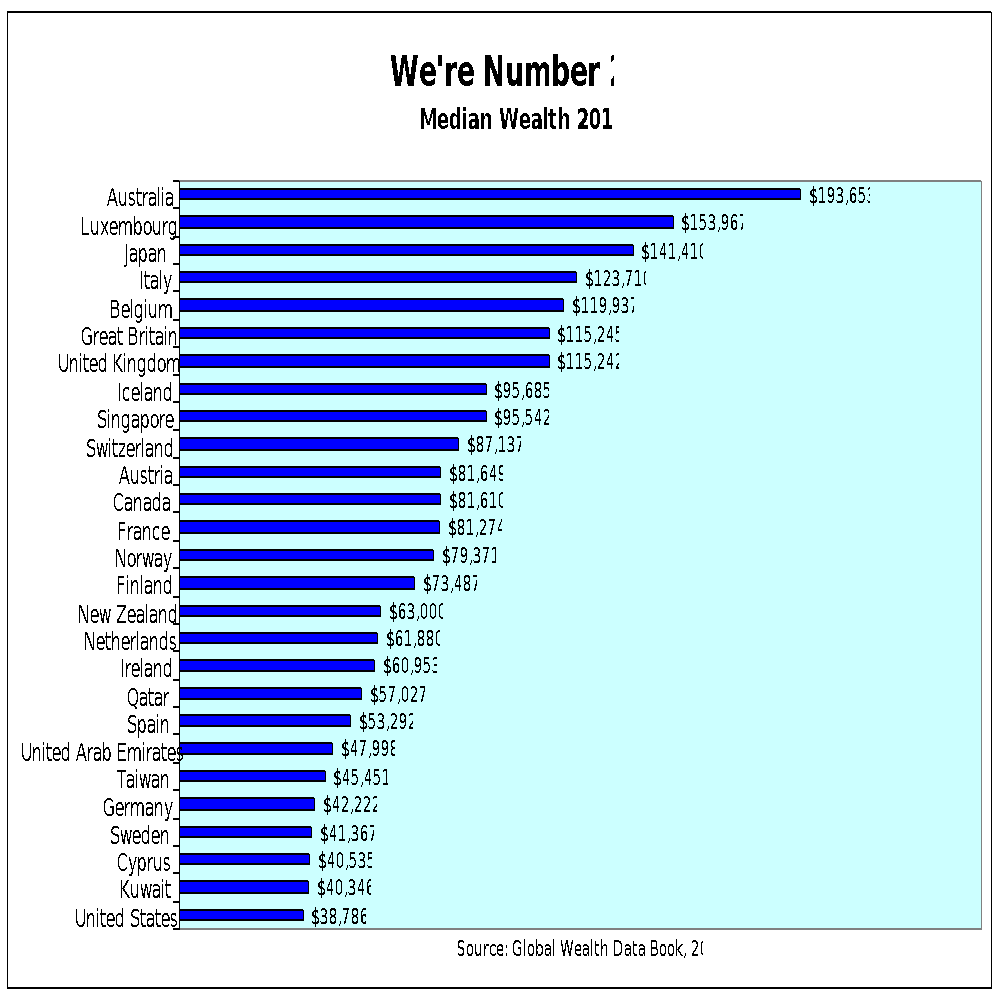
Our middle class is falling further and further behind in comparison to the rest of the world. We keep hearing that America is number one. Well, when it comes to middle-class wealth, we're number 27.  

The most telling comparative measurement is median wealth (per adult). It describes the amount of wealth accumulated by the person precisely in the middle of the wealth distribution—50 percent of the adult population has more wealth, while 50 percent has less. You can't get more middle than that.

Wealth is measured by the total sum of all our assets (homes, bank accounts, stocks, bonds etc.) minus our liabilities (outstanding loans and other debts). It the best indicator we have for individual and family prosperity. While the never-ending accumulation of wealth may be wrecking the planet, wealth also provides basic security, especially in a country like ours with such skimpy social programs. Wealth allows us to survive periods of economic turmoil. Wealth allows our children to go to college without incurring crippling debts, or to get help for the down payment on their first homes. As Billie Holiday sings, "God bless the child that's got his own."  

Well, it's a sad song. As the chart below shows, there are 26 other countries with a median wealth higher than ours (and the relative reduction of U.S. median wealth has done nothing to make our economy more sustainable).


Why?

Here's a starter list:
  • We don't have real universal healthcare. We pay more and still have poorer health outcomes than all other industrialized countries. Should a serious illness strike, we also can become impoverished.
  • Weak labor laws undermine unions and give large corporations more power to keep wages and benefits down. Unions now represent less than 7 percent of all private sector workers, the lowest ever recorded.
  • Our minimum wage is pathetic, especially in comparison to other developed nations. (We're # 13.) Nobody can live decently on $7.25 an hour. Our poverty-level minimum wage puts downward pressure on the wages of all working people. And while we secure important victories for a few unpaid sick days, most other developed nations provide a month of guaranteed paid vacations as well as many paid sick days.
  • Wall Street is out of control. Once deregulation started 30 years ago, money has gushed to the top as Wall Street was free to find more and more unethical ways to fleece us.  
  • Higher education puts our kids into debt. In most other countries higher education is practically tuition-free. Indebted students are not likely to accumulate wealth anytime soon.  
  • It's hard to improve your station in life if you're in prison, often due to drug-related charges that don't even exist in other developed nations. In fact, we have the largest prison population in the entire world, and we have the highest percentage of minorities imprisoned. “In major cities across the country, 80% of young African Americans now have criminal records” (from Michelle Alexander's 2010 book, The New Jim Crow: Mass Incarceration in the Age of Colorblindness).
  • Our tax structures favor the rich and their corporations that no longer pay their fair share. They move money to foreign tax havens, they create and use tax loopholes, and they fight to make sure the source of most of their wealth—capital gains—is taxed at low rates. Meanwhile the rest of us are pressed to make up the difference or suffer deteriorating public services.
  • The wealthy dominate politics. Nowhere else in the developed world are the rich and their corporations able to buy elections with such impunity.
  • Big Money dominates the media. The real story about how we're getting ripped off is hidden in a blizzard of BS that comes from all the major media outlets...brought to you by....
  • America encourages globalization of production so that workers here are in constant competition with the lower-wage workers all over the world as well as with highly automated techonologies.
Is there one cause of the middle-class collapse that rises above all others?
Yes. The International Labor organization produced a remarkable study (Global Wage Report 2012-13) that sorts out the causes of why wages have remained stagnant while elite incomes have soared. The report compares key causal explanations like declining bargaining power of unions, porous social safety nets, globalization, new technologies and financialization.  

Guess which one had the biggest impact on the growing split between the 1 percent and the 99 percent?
Financialization!   

What is that? Economist Gerald Epstein offers us a working definition:
"Financialization means the increasing role of financial motives, financial markets, financial actors and financial institutions in the operation of the domestic and international economies."
This includes such trends as:
  • The corporate change during the 1980s to make shareholder value the ultimate goal.
  • The deregulation of Wall Street that allowed for the creation of a vast array of new financial instruments for gambling.
  • Allowing private equity firm to buy companies, load them up with debt, extract enormous returns, and then kiss them goodbye.
  • The growth of hedge funds that suck productive wealth out of the economy.
  • The myriad of barely regulated world financial markets that finance the globalization of production, combined with so-called "free trade" agreements.
  • The increased share of all corporate profits that go to the financial sector.
  • The ever increasing size of too-big-to-fail banks.
  • The fact that many of our best students rush to Wall Street instead of careers in science, medicine or education.
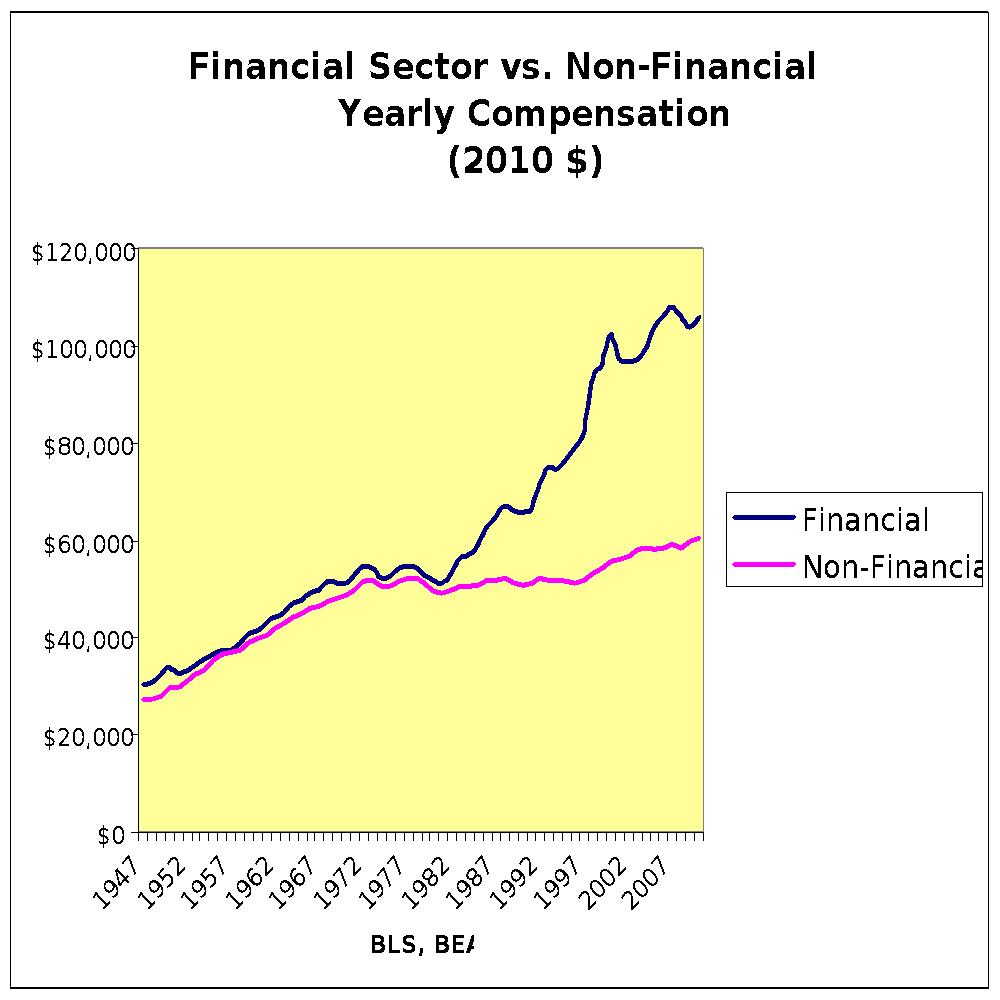
In short, financialization is when making money from money becomes more important that providing real goods and services. Here's a chart that says it all. Once we unleashed Wall Street, their salaries shot up, while everyone else's stood still.


Do we still know how to fight!

The carefully researched ILO study provides further proof that Occupy Wall Street was right on the money. OWS succeeded (temporarily), in large part, because it tapped into the deep reservoir of anger toward Wall Street felt by people all over the world. We all know the financiers are screwing us.
Then why didn't OWS turn into a sustained, mass movement to take on Wall Street?

One reason it didn't grow was that the rest of us stood back in deference to the original protestors instead of making the movement our own. As a result, we didn't build a larger movement with the structures needed to take on our financial oligarchs. And until we figure out how to do just that, our nation's wealth will continue to be siphoned away.  

Our hope, I believe, lies in the young people who are engaged each day in fighting for the basic human rights for all manner of working people—temp workers, immigrants, unionized, non-union, gays, lesbians, transgender—as well as those who are fighting to save the planet from environmental destruction. It's all connected.

At some point these deeply committed activists also will understand that financialization both here and abroad stands in the way of justice and puts our planet at risk. When they see the beast clearly, I am confident they will figure out how to slay it.  

The sooner, the better.

Les Leopold's latest book is How to Make a Million Dollars an Hour: Why Hedge Funds are Siphoning away America's Wealth (John Wiley and Sons, 2013).

Saturday, June 15, 2013

How America's Bully Economy leads to a "Bully Society"


Jessie Klein's new book explains how school shootings, bullying, and stressed-out kids stem in part from the US's cutthroat economy. 


Photo Credit: New York University Press


The following is an excerpt from Jessie Klein's new book "The Bully Society: School Shootings and the Crisis of Bullying in America's Schools," (New York University Press, 2013).


Schools are microcosms of American society where students are told that  financial wealth and superficial gender markers are compulsory for social acceptance. They learn these lessons from each other but also from grown-ups—parents, teachers,  and the wider culture  they inhabit. As they prepare to enter the adult workforce and social life, children come to understand that being perceived as the richest or prettiest, or the most powerful or confident, could  dramatically  enhance their futures—and that without  these marks of American success they may become lifelong outcasts. They also learn to see life as a zero-sum game, where they can win only if someone else loses, rise only by ensuring  that  someone else falls. These values are at the core of bullying behavior, and they are also the foundation upon which much of the economic, political, and social life of our nation is built.

Not all cultures are so obsessively focused on winning. In the Southwest, for instance, coaches say that teams of Hopi Indians want to win but that they often try not to win because they don’t want to embarrass their opponents. In some traditional cultures, the game isn’t over until the two sides are tied. They work hard to make sure no one loses. Even in Europe, as T. R. Reid writes in “The European Social Model,” some core human needs  are seen as everyone’s birthright rather  than  as something to be “won” through competition with one’s compatriots. “To Americans,” Reid writes, “it is simply a matter  of common sense that rich families get better medical care and education than the poor; the rich can afford the doctors at the fancy clinics and the tutors  to get their kids into Harvard.  But this piece of common sense does not apply in most of Europe. The corporate executive in the back seat of the limo, her chauffeur up front, and the guy who pumps the gas for them all go to the same doctor  and the same hospitals and send their children to the same (largely free) universities.”

In the United States, however, hardcore competition and striving to be the best are generally considered vital to keeping people motivated  and functioning at optimal  levels. Harsh  inequalities  are considered, at best, an  unfortunate consequence. Yet gender  pressures—and especially the expectation to embrace  hypermasculine values and  behaviors—are  seldom examined in the context of the larger socioeconomic forces that shape them.

In one of my criminal justice classes, I asked students to tell me what words they associated  with capitalism.  What  qualities do you need to be successful in our society? The board filled up quickly: competitive, aggressive,and powerfulwere some of the first suggestions. At that point, we were discussing white-collar crime and the unprincipled behavior that had produced both the Enron scandal and the economic meltdown of recent years. Later in the course we discussed  school shootings  and their  relationship to gender, and I asked my students to list some words they associated with masculinity. The same list emerged—competitive,  aggressive, and powerful. Without intending to, my students had highlighted  the link between  the values of masculinity and capitalism.The school shooters,  for the most  part, grew up in the 1980s or later. The rise in school shootings  roughly coincides with the Reagan administration’s restructuring of the American  economic,  political, and cultural landscape—a period that glorified unrestrained capitalism and reemphasized an “up by your own bootstraps” ethos. Following a landslide reelection in 1984, Reagan promised  an America  rich with freedom,  individualism,  and  financial reward for  those  who  skillfully met  the  standard, coupled  with a lower degree of support for those  who did not. Increasingly, success was defined in terms  of power, economic  attainment, and social status—the same barometers increasingly used, at the high school level, to assess masculinity.

Capitalism  is hardly new to the United States, nor is the system’s relationship  to core American  values. But as former  labor secretary  Robert Reich observed in his book Supercapitalism, in recent decades the power of unregulated, unrestrained capital has increased  to such an extent  that it has outstripped democracy as a primary foundation of our society. According  to Reich, Americans  became identified  more as investors  and consumers and less as citizens and members of a community.

Further,  in this same period, a slew of books documenting America’s increasing social problems hit the shelves. The titles alone explain why Americans  are more  stressed, broke, unhappy, and doing whatever they can to survive: The Overworked American  (1993), The Overspent American(1998), The Cheating Culture(2000), and The Lonely American(2009). Another set of recent titles document the new plagues with which our children  are grappling—increased anxiety, depression,  materialism, and even narcissistic personality  diagnosis: Branded: The Buying and Selling of Teenagers(2004); The Road to Whatever: Middle-Class Culture and The Crisis of Adolescence(2004); The Price of Privilege: How Parental Pressure and Material Advantage Are Creating a Generation of Disconnected and Unhappy Kids(2006); and Generation Me: Why Today’s Young Americans  Are More Confident,   Assertive,  Entitled—and More Miserable Than Ever Before(2007). Couple these telling titles with the alarming statistics depicting the United States as scoring highest on almost all of the worst social problems in the industrialized world (including  murder, rape, and infant mortality), and it becomes less surprising that school bullying is so common here, or that its vicious and fatal retaliations in the form of shootings are more prevalent in the United States than in the rest of the world combined.

What is a Compassionate Economy?


Competitive and punishment-oriented schools mirror  the combative workforce. In the larger world, adults are given little support if they meet hard times and are unable at some point to work at their best, or work at all. Similarly, as adolescents  struggle to find their identities and their place in the world, the emotional ups and downs of their journey can undermine academic performance. Even students who tend to do well risk failure, and their confrontations with widespread  cliques and bullying only add to the stress.  Children’s  understanding of this  antagonistic culture feeds their  fury and fear as they find that  their every move in school so profoundly  affects their future prospects.

In his book Going Postal: Rage, Murder, and Rebellion: From Reagan’s Workplaces  to Clinton’s Columbine  and Beyond, Mark Ames writes:
“The kids are stressed  out not only by their  own pressure  at school, but by the stress their parents endure in order to earn enough money  to live in [a prestigious] school district.  ... Everyone is terrified of not ‘making it’ in a country where the safety net has been torn to shreds.”  
Children who might otherwise look forward to a life after high school see, in the model of their parents and the larger society around them, a similarly brutal environment.

While their safety nets are weakening as well, in most European countries the government still takes some responsibility for ensuring that everyone has basic health care, education,  housing, food, child care, elder care, and even indefinite unemployment if necessary. There are real limitson work hours (in Finland, for instance, a six-hour workday), and mandatory paid vacation and holiday time is often four to six weeks.

In contrast, even before the start of the latest recession, workers in twentieth-century America were losing some of the gains they had fought for in the earlier part of that century. The eight-hour day (forty-hour week) that Americans finally won in 1938, under President Roosevelt’s New Deal Fair Labor Standards Act, is a dim memory for most Americans  today, who tend  to toil more  often at fifty to seventy or more  hours  per week.

Americans  once hoped to achieve the demands  made by the Welsh social reformer  Robert Owen for eight hours of work, eight hours of leisure, and eight hours of sleep, but most now have little if any leisure and much less sleep. We are working much longer hours than our counterparts in other industrialized countries. John P. Walsh and Anne Zacharias-Walsh write in “Working  Longer, Living Less” that  the average American  works seventy more hours per year than  his or her Japanese counterpart and 350 hours  or nine more  weeks per year than  Europeans. Americans  tend to work more hours and then spend money paying others  to do the services they don’t have time to do because of they are working.

Because we Americans work so much, it becomes more difficult to take care of our children and our homes. In many European countries, the government pays mothers as well as fathers  to stay home  with their  young children  so they can return to work when  the  children  are older. In the United  States, middle-and upper-class adults make money and often pay other  people to do these tasks; many small children  in the United  States are under  the  care of nannies  or some  other  form  of child care worker. Rather than a system designed to meet human  needs, our economy prioritizes profit. Instead of opportunities to nurture ourselves, and our friends and family, and larger community, our time is managed by someone  else’s drive to make  money.  Walsh  and  Zacharias-Walsh write  that  “to argue that  an expensive factory should be left idle because workers are tired or that production should be organized  using a less efficient but more comfortable  process—is considered absurd.”  Yet the “overworked American,” to use Juliet Schor’s term,  does not  necessarily  generate  more  profit. As Anders Hayden notes,
“Several shorter-hours innovators in Europe—Belgium, France,  the Netherlands, and Norway—are  actually more  productive per hourof labor than is the United States. Higher hourly productivity in these countries is almost  certainly  due, in part, to shorter work-time’s beneficial effects on employee morale, less fatigue and burnout, lower absenteeism, higher quality of work, and better health.”
European economies  tend to prioritize  family and community as a primary value. The notion of “time affluence,” not just “material affluence,” is important—a concept  that is less common in the United States. Instead, Americans  work longer and live with their family less. Walsh and Zacharias-Walsh  write about  one mother of two young children  who summed up this  collective  quandary:  “This is the  only job I could  get that  paid enough  for me to take care of them,  but it never lets me be home  when they need me. I can either  feed them  or be with them, never both.”  The increased  workday also prevents  participation in community life—politi- cal organizations, social clubs, sports  leagues, religious  institutions—as well as family life, leading  to what  Robert  Putnam called the  “Bowling Alone” phenomenon; other  research  also notes  a related  plummeting of social connections and increased  loneliness and isolation among Americans.

In  recent  decades,  the  U.S. government has  taken  less responsibility for people’s basic human  needs. Life has become  a struggle for many working  parents,  especially single working  parents.  In addition  to lacking the  government-supported universal  health  care that  is available to citizens  in virtually  all European  countries, the  United  States  does  less than any other industrialized country  to support parents,  who receive no legally mandated paid leave when a child is born or adopted.  Among the168 nations  surveyed in a 2004  Harvard  University  study, 163 have paid maternity leave, while the United  States stands  in a category with Lesotho, Papua New Guinea, and Swaziland.

The lack of economic  support for American  citizens  means  adults are under  more  pressure  and  stress  to keep their  jobs and  succeed  in them  in order  to support themselves  and their  families. Driven to succeed, with dwindling access to community, adults end up forming similar social cliques to those that fester in children’s schools. Workplace massacres, then, tend to have causes that parallel those found in school shootings.

Jessie Klein, PhD, MSW, M.Ed., is the Author of The Bully Society. She is assistant sociologist/criminal justice professor at Adelphi University where she specializes in school violence, friendship, and gender. Her work has appeared in USA Today, Newsday, and The New York Times, as well as scholarly journals. During her more than twenty years in education, she also served as a teacher, councelor, guidance administrator, and social work professor. She lives in New York City.

Thursday, June 13, 2013

The Great Economic Divide: The Shocking Amount of Wealth and Power Held by 0.001% of the World Population


Economy  


The level of inequality around the world is truly staggering. 


Many now know the rhetoric of the 1% very well: the imagery of a small elite owning most of the wealth while the 99% take the table scraps.

In 2006, a UN report revealed that the world’s richest 1% own 40% of the world’s wealth, with those in the financial and internet sectors comprising the “super rich.” More than a third of the world’s super-rich live in the U.S., with roughly 27% in Japan, 6% in the U.K., and 5% in France. The world’s richest 10% accounted for roughly 85% of the planet's total assets, while the bottom half of the population – more than 3 billion people – owned less than 1% of the world’s wealth.

Looking specifically at the United States, the top 1% own more than 36% of the national wealth and more than the combined wealth of the bottom 95%. Almost all of the wealth gains over the previous decade went to the top 1%. In the mid-1970s, the top 1% earned 8% of all national income; this number rose to 21% by 2010. At the highest sliver at the top, the 400 wealthiest individuals in America have more wealth than the bottom 150 million.

A 2005 report from Citigroup coined the term “plutonomy” to describe countries “where economic growth is powered by and largely consumed by the wealthy few.” The report specifically identified the U.K., Canada, Australia and the United States as four plutonomies. Published three years before the onset of the financial crisis in 2008, the Citigroup report stated: “Asset booms, a rising profit share and favorable treatment by market-friendly governments have allowed the rich to prosper and become a greater share of the economy in the plutonomy countries.”

"The rich," said the report, "are in great shape, financially.”

In early 2013, Oxfam reported that the fortunes made by the world’s 100 richest people over the course of 2012 – roughly $240 billion – would be enough to lift the world’s poorest people out of poverty four times over. In the Oxfam report, "The Cost of Inequality: How Wealth and Income Extremes Hurt Us All," the international charity noted that in the past 20 years, the richest 1% had increased their incomes by 60%. Barbara Stocking, an Oxfam executive, noted that this type of extreme wealth is “economically inefficient, politically corrosive, socially divisive and environmentally destructive...We can no longer pretend that the creation of wealth for a few will inevitably benefit the many – too often the reverse is true.”

The report added: “In the UK, inequality is rapidly returning to levels not seen since the time of Charles Dickens. In China the top 10% now take home nearly 60% of the income. Chinese inequality levels are now similar to those in South Africa, which is now the most unequal country on Earth and significantly more unequal than at the end of apartheid.” In the United States, the share of national income going to the top 1% has doubled from 10 to 20% since 1980, and for the top 0.01% in the United States, “the share of national income is above levels last seen in the 1920s.”

Previously, in July of 2012, James Henry, a former chief economist at McKinsey, a major global consultancy, published a major report on tax havens for the Tax Justice Network which compiled data from the Bank for International Settlements (BIS), the IMF and other private sector entities to reveal that the world’s super-rich have hidden between $21 and $32 trillion offshore to avoid taxation.

Henry stated: “This offshore economy is large enough to have a major impact on estimates of inequality of wealth and income; on estimates of national income and debt ratios; and – most importantly – to have very significant negative impacts on the domestic tax bases of ‘source’ countries.” John Christensen of the Tax Justice Network further commented that “Inequality is much, much worse than official statistics show, but politicians are still relying on trickle-down to transfer wealth to poorer people... This new data shows the exact opposite has happened: for three decades extraordinary wealth has been cascading into the offshore accounts of a tiny number of super-rich.”

With roughly half of the world’s offshore wealth, or some $10 trillion, belonging to 92,000 of the planet's richest individuals —representing not the top 1% but the top 0.001% — we see a far more extreme global disparity taking shape than the one invoked by the Occupy movement. Henry commented: “The very existence of the global offshore industry, and the tax-free status of the enormous sums invested by their wealthy clients, is predicated on secrecy.”

In his 2008 book, "Superclass: The Global Power Elite and the World They Are Making," David Rothkopf, a man firmly entrenched within the institutions of global power and the elites which run them, compiled a census of roughly 6,000 individuals whom he referred to as the “superclass.” They were defined not simply by their wealth, he said, but by the influence they exercised within the realms of business, finance, politics, military, culture, the arts and beyond.
Rothkopf noted: “Each member is set apart by his ability to regularly influence the lives of millions of people in multiple countries worldwide. Each actively exercises this power and often amplifies it through the development of relationships with other superclass members.”

The global elite are of course not defined by their wealth alone, but through the institutional, ideological and individual connections and networks in which they wield their influence. The most obvious example of these types of institutions are the multinational banks and corporations which dominate the global economy. In the first scientific study of its kind, Swiss researchers analyzed the relationship between 43,000 transnational corporations and “identified a relatively small group of companies, mainly banks, with disproportionate power over the global economy.”

In their report, "The Network of Global Corporate Control, researchers noted that this network – which they defined as "ownership" by a person or firm over another firm, whether partially or entirely – “is much more unequally distributed than wealth” and that “the top ranked actors hold a control ten times bigger than what could be expected based on their wealth.” The “core” of this network – which consists of the world's top 737 corporations – control 80% of all transnational corporations (TNCs).

Even more extreme, the top 147 transnational corporations control roughly 40% of the entire economic value of the world’s TNCs, forming their own network known as the “super-entity.” The super-entity conglomerates all control each other, and thus control a significant portion of the rest of the world’s corporations with the “core” of the global corporate network consisting primarily of financial corporations and intermediaries.

In December of 2011, the former deputy secretary of the Treasury in the Clinton administration, Roger Altman, wrote an article for the Financial Times in which he described financial markets as “a global supra-government” which can “oust entrenched regimes... force austerity, banking bail-outs and other major policy changes.” Altman said bluntly that the influence of this entity “dwarfs multilateral institutions such as the International Monetary Fund” as “they have become the most powerful force on earth.”

With the formation of this “super-entity” – a veritable global supra-government – made up of the world’s largest banks and corporations exerting immense influence over all other corporations, a new global class structure has evolved. It is this rarefied group of individuals and firms, and the relations they hold with one another, that we wish to further understand.

According to the 2012 report, "Corporate Clout Distributed: The Influence of the World’s Largest 100 Economic Entities," of the world’s 100 largest economic entities in 2010, 42% were corporations while the rest were governments. Among the largest 150 economic entities, 58% were corporations. Wal-Mart was the largest corporation in 2010 and the 25th largest economic entity on earth, with greater revenue than the GDPs of no less than 171 countries.

According to the Fortune Global 500 list of corporations for 2011, Royal Dutch Shell next became the largest conglomerate on earth, followed by Exxon, Wal-Mart, and BP. The Global 500 made record revenue in 2011 totaling some $29.5 trillion — more than a 13% increase from 2010.

With such massive wealth and power held by these institutions and "networks" of corporations, those individuals who sit on the boards, executive committees and advisory groups to the largest corporations and banks wield significant influence on their own. But their influence does not stand in isolation from other elites, nor do the institutions of banks and corporations function in isolation from other entities such as state, educational, cultural or media institutions.
Largely facilitated by the cross-membership that exists between boards of corporations, think tanks, foundations, educational institutions and advisory groups — not to mention the continual "revolving door" between the state and corporate sectors — these elites become a highly integrated, organized and evolved social group. This is as true for the formation of national elites as it is for transnational, or global, elites.

The rise of corporations and banks to a truly global scale – what is popularly referred to as the process of “globalization” – was facilitated by the growth of other transnational networks and institutions such as think tanks and foundations, which sought to facilitate these ideological and institutional structures of globalization. A wealth of research and analysis has been undertaken in academic literature over the past couple of decades to understand the development of this phenomenon, examining the emergence of what is often referred to as the "Transnational Capitalist Class" (TCC). In various political science and sociology journals, researchers and academics reject a conspiratorial thesis and instead advance a social analysis of what is viewed as a powerful social system and group.

As Val Burris and Clifford L. Staples argued in an article for the International Journal of Comparative Sociology (Vol. 53, No. 4, 2012), “as transnational corporations become increasingly global in their operations, the elites who own and control those corporations will also cease to be organized or divided along national lines.” They added: “We are witnessing the formation of a ‘transnational capitalist class’ (TCC) whose social networks, affiliations, and identities will no longer be embedded primarily in the roles they occupy as citizens of specific nations.” To properly understand this TCC, it is necessary to study what the authors call “interlocking directorates,” defined as “the structure of interpersonal or interorganizational relations that is created whenever a director of one corporation sits on the governing board of another corporation.”
The growth of “interlocking directorates” is primarily confined to European and North American conglomerates, whereas those in Asia, Latin America and the Middle East largely remain “isolated from the global interlock network.” Thus, the “transnationalization” of corporate directorates and, ultimately, of global class structures “is more a manifestation of the process of European integration – or, perhaps, of the emergence of a North Atlantic ruling class.”

The conclusion of these researchers was that the ruling class is not “global” as such, but rather “a supra-national capitalist class that has gone a considerable way toward transcending national divisions,” notably in the industrialized countries of Western Europe and North America; in their words, "the regional locus of transnational class formation is more accurately described as the North Atlantic region.” However, with the rise of the "East" – notably the economic might of Japan, China, India, and other East Asian nations – the interlocks and interconnections among elites are likely to expand as various other networks of institutions seek to integrate these regions.

The influence wielded by banks and corporations is not simply through their direct wealth or operations, but through the affiliations, interactions and integration by those who run the institutions with political and social elites, both nationally and globally. While we can identify a global elite as a wealth percentage (the top 1% or, more accurately, the top 0.001%), this does not account for the more indirect and institutionalized influence that corporate and financial leaders exert over politics and society as a whole.

To further understand this, we must identify and explore the dominant institutions which facilitate the integration of these elites from an array of corporations, banks, academia, the media, military, intelligence, political and cultural spheres.


Andrew Gavin Marshall is an independent researcher and writer based in Montreal, Canada. He is Project Manager of The People’s Book Project, head of the Geopolitics Division of the Hampton Institute, Research Director for Occupy.com’s Global Power Project and hosts a weekly podcast show at BoilingFrogsPost.